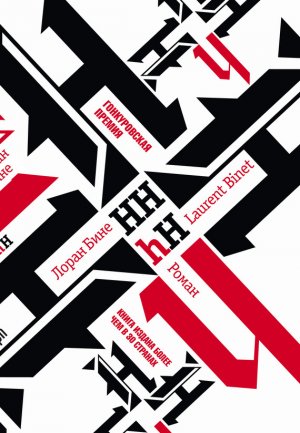
HHhH Бине Лоран
It’s May 26, 1942. The day before…
137
Gabk the Slovak and Kubi the Moravian have never been to Prague, and in fact this is one of the reasons they were chosen. If they don’t know anyone, they won’t be recognized. But their lack of local knowledge is also a handicap, so part of their intensive training involves studying maps of their beautiful capital.
Gabk and Kubi pore over a map of Prague, memorizing the main squares and streets. At this point, they have never set foot upon the Charles Bridge or the Old Town Square, the hills of Petn and Strahov, the banks of the Vltava, Wenceslas Square or Charles Square, the courtyard of Hradany Castle, or the cemetery of Vyehrad Castle, where Vitezslav Nezval—author of the immortal collection of poems Prague with Fingers of Rain—is not yet buried. They have never laid eyes on the sad islands in the river with their swans and ducks, nor the bluish towers of Tn Church, nor the Astronomical Clock on City Hall with its little automated figures that move every hour. They still haven’t drunk a hot chocolate in the Caf Louvre or a beer in the Caf Slavia. They have not been eyed scornfully by the statue of the iron man in Platnsk Street. For now, the lines on the map evoke nothing more than names learned as children or military objectives. To see them studying the city’s topography, you might easily believe them—were it not for the uniforms—to be vacationers, planning their trip with particular care.
138
Heydrich receives a delegation of Czech yokels. He is not very welcoming. He listens in silence to their groveling promises of cooperation, then explains to them that Czech farmers are saboteurs. They fiddle with their inventories of livestock and grain. To what end? For the black market, obviously. Heydrich has already begun executing butchers and wholesalers, but to have any real effect in combating this scourge that starves the people he must gain total control of agricultural production. So Heydrich threatens them: all farmers who fail to give a precise account of their production will have their farms confiscated. The yokels are stunned. They know that if Heydrich decided to burn them alive in the Old Town Square, no one would come to their aid. To be complicit in the black market is to take food from the mouths of the people, and on this point the people support Heydrich’s laws. The Hangman of Prague thus achieves a political masterstroke: creating a reign of terror and applying a popular law at the same time.
As soon as the yokels have gone, Karl Hermann Frank—his secretary of state—wants to start drawing up a list of farms to be confiscated. Heydrich tells him to calm down. The only farms that will be confiscated are those run by farmers judged unfit for Germanization.
Come on—this isn’t the Soviet Union, you know!
139
Perhaps the scene took place in Heydrich’s wood-paneled office. Heydrich is busying himself with his dossiers, when there’s a knock at the door. A man in uniform enters the room—an expression of terror on his face, a piece of paper in his hand.
“Herr Obergruppenfhrer, the news has just arrived! Germany has declared war on the United States!”
Heydrich doesn’t blink. The man hands him the message. He reads it in silence.
A long moment passes.
“What are your orders, Herr Obergruppenfhrer?”
“Take a detachment of men to the train station and remove the statue of Wilson.”
“…”
“I don’t expect to see that piece of crap there tomorrow morning. Do it, Major Pomme!”
140
President Bene knows that he will have to face up to his reponsibilities. Come what may, he must prepare for the mass reprisals that the Germans will undoubtedly unleash if Operation Anthropoid succeeds. To govern is to choose, and the decision has been made. But making a decision is one thing; taking responsibility for it is something else. And Bene—who founded Czechoslovakia with Tom Masaryk in 1918 and who, twenty years later, was unable to avoid the disaster of Munich—knows that the pressure of history is enormous, and that the judgment of history is the most terrible of all. All his efforts from now on are aimed at restoring the integrity of the country he created. Unfortunately, the liberation of Czechoslovakia is not in his hands. The RAF and the Red Army will decide its fate. Admittedly, Bene has been able to provide seven times more pilots for the RAF than the French have. And the record for the highest number of enemy planes shot down is hld by Josef Frantiek: the ace of British aviation is a Czech. Bene is more than a little proud of this. But he also knows that in times of war, the power of a head of state is measured only by the numbers of his divisions. For this reason, his activities have been almost entirely reduced to a humiliating diplomacy: he must give pledges of goodwill to the only two powers still resisting the Germans, without any certainty that those two powers will end up victorious. It’s true that, confronted by German bombardments in 1940, Britain was able to ride the blow and win the air battle—for the moment at least. It’s also true that the Red Army, having been pushed all the way back to Moscow, was able to stop the enemy advance just before it reached its goal. Britain and the USSR, having each barely avoided collapse, are today in a position to fight back against the Reich. But this is late 1941. The Wehrmacht is almost at the zenith of its power. It still hasn’t suffered any significant defeat to dent the myth of its invincibility. Stalingrad is still far off—we are a long way from seeing images of defeated German soldiers, eyes lowered to the snow. All Bene can do is gamble on an uncertain outcome. The entry of the United States into the war is naturally a source of great hope, but the GIs have yet to cross the Atlantic and they are still so busy fighting the Japanese that they pay no attention to the fate of a small country in central Europe. Thus Bene makes his own version of Pascal’s wager: his god is a god with two heads—Britain and the USSR—and he bets on their survival. But to keep two heads happy at the same time is not easy. Britain and the USSR are, of course, allies. And Churchill, despite his inborn anticommunism, will show an indestructible loyalty to the Soviet Union, in military terms, throughout the war. As for what happens after the war—if the war ends and if the Allies win—well, that is obviously another story.
With Anthropoid, Bene is attempting a great coup to impress these two European giants. London has given logistical backing and collaborated closely. But Bene has to be careful not to offend the Russians’ pride: that’s why he has decided to inform Moscow of the launch of the operation. So the pressure is now at its height: Churchill and Stalin are waiting. The future of Czechoslovakia is in their hands; best not disappoint them. Above all, if it’s the Red Army that liberates his country, Bene wants Stalin to regard him as a credible representative—all the more so given his fears of the Czech Communists’ influence.
Bene is probably thinking about all this when his secretary comes to warn him:
“Mr. President, Colonel Moravec is here with two young men. He says he’s got an appointment, but there’s nothing in today’s schedule about it.”
“Let them in.”
Gabk and Kubi have been brought by taxi through the streets of London without any idea where they were going, and now they are received by the president himself. On his desk, the first thing they notice is a little tin replica of a Spitfire. They salute and stand to attention. Bene wanted to meet them before their departure but didn’t want to leave any official record of their visit—because to govern is also to take precautions. The two men stand before him. While he talks to them of their mission’s historic importance, he observes them carefully. He’s struck by how young they look—Kubi especially, although he’s only one year younger than Gabk—and by the touching simplicity of their determination. For several minutes, he forgets all the geopolitical considerations. He no longer thinks of Britain and the USSR, nor of Munich, or Masaryk, or the Communists, or the Germans. He hardly even thinks of Heydrich. He is completely absorbed in the contemplation of these two soldiers, these two boys whom he knows—whatever the outcome of their mission—haven’t got a chance in hell of getting out alive.
I don’t know what his last words to them are. “Good luck,” or “God keep you,” or “The free world is counting on you,” or “You carry in your hands the honor of Czechoslovakia”… something like that, probably. According to Moravec, the president has tears in his eyes when Gabk and Kubi leave his office. Perhaps he has a premonition of the terrible future. The impassive little Spitfire keeps its nose in the air.
141
Since joining her husband in Prague, Lina Heydrich is in heaven. She writes in her autobiography: “I am a princess and I live in a fairy-tale land.”
How come?
First, because Prague really is a fairy-tale city. Not for nothing did Walt Disney take his inspiration for the queen’s castle in Sleeping Beauty from Tn Church.
Next, because in Prague she really is the queen. Overnight her husband has become almost a head of state. In this fairy-tale land, he is Hitler’s viceroy and his wife shares all the honors of his rank. As the Protector’s spouse, Lina enjoys an esteem that her parents—the von Ostens—never dreamed of, for her or for themselves. How long ago it seems that her father wanted to break off her engagement because Reinhard had been kicked out of the navy. Now, thanks to him, Lina’s life is an endless series of receptions, inaugurations, and official events where everyone shows her the greatest deference. I see her in a photo taken at a concert at the Rudolfinum to celebrate the anniversary of Mozart’s birth. Dolled up in a white evening dress, weighed down with rings, bracelets, and earrings, surrounded by men in smoking jackets all currying favor with her husband, who stands by her side… smiling, relaxed, and sure of herself, she stands with one hand resting chastely on top of the other and with a look of ecstatic happiness on her face.
But it’s not only Prague. From now on, her husband’s position allows her to mix with the Reich’s high society. Himmler is a long-standing friend, but she also knows the Goebbelses and the Speers, and she’s even had the supreme honor of meeting the Fhrer, who, seeing her on her husband’s arm, remarked: “What a handsome couple!” Oh yes, she’s part of the upper crust now. And Hitler pays her compliments!
And she has her own castle: a palace confiscated from a Jew, twelve miles north of Prague, surrounded by a vast estate. Wildly enthusiastic, she gets to work on doing it up. She is the lady of the manor but, like the queen in Sleeping Beauty, she is also a nasty piece of work. She treats her staff harshly, and insults everyone when she’s in a bad mood—and when she’s in a good mood, she doesn’t speak to anyone. In order to perform the enormous amount of work required for her princely home, she makes use of the abundant manpower supplied by the concentration camps. She doesn’t treat these workers any better than the camps do. She supervises the renovation work dressed as a horsewoman, a riding crop in her hand. Hers is a reign of terror, sadism, and eroticism.
Apart from all that, she looks after her three children and congratulates herself on how affectionate Reinhard is with them. He particularly adores the youngest one, Silke. So much so that he impregnates his wife for the fourth time. Long gone are the days when she would sleep with Schellenberg, his right-hand man. Long gone the days when he was never home. Here in Prague, her husband returns almost every evening. He makes love to her, goes horse riding, and plays with the children.
142
Gabk and Kubi are going home in a Halifax bomber. But before that there are certain formalities to be taken care of. From behind his desk, a British NCO asks them to undress. No matter where in the Czech countryside they land, it’s not a good idea to look like British parachutists. They take off their uniforms. “Completely,” adds the NCO as they stand there in their underwear. Used to discipline, the two men obey. So they’re strk naked when a choice of clothing is spread out before them. Without losing any of his very British, very military dryness, the NCO makes his pitch like a sales assistant at Harrods, proudly presenting his products: “Suits made in Czechoslovakia. Shirts made in Czechoslovakia. Underwear made in Czechoslovakia. Shoes made in Czechoslovakia. Please check your size. Ties made in Czechoslovakia. Choose a color. Cigarettes made in Czechoslovakia. Several brands available. Matches made in… Toothpaste made in…”
Once they’re dressed, the two men are given false papers with all the necessary stamps.
Now they are ready. Colonel Moravec waits for them next to the Halifax, whose engines are already running. There are five other parachutists in the plane with them, but they are going to different places on different missions. Moravec shakes Kubi’s hand and wishes him good luck. But when he turns toward Gabk, the little Slovak asks if they can have a quick word in private. Moravec cringes inwardly. He fears a last-minute withdrawal and suddenly regrets what he said to the two boys when he first chose them that they shouldn’t hesitate to tell him frankly if they didn’t feel up to the task. He’d even added that there was nothing shameful in changing your mind. He still believes this, but standing next to the waiting airplane is not the ideal time to hear it. He’d have to get Kubi off the plane and delay the departure while he found a replacement for Gabk. The mission would be postponed till God knows when. Gabk begins with a few carefully phrased words that don’t bode well: “Colonel, I’m very embarrassed to ask this…” But what comes next allays his boss’s fears: “I’ve left an unpaid bill for ten pounds at our restaurant. Could you possibly pay it for me?” Moravec is so relieved that he says in his memoirs he could do nothing more than nod. Gabk shakes his hand. “You can count on us, Colonel. We’ll fulfill our mission exactly as ordered.” Those were his last words before disappearing into the cabin.
143
The two men wrote down their final wishes just before they took off, and I have these magnificent, hastily scribbled documents in front of me now. Covered in inkstains and crossings-out, they are almost identical. Both are dated December 28, 1941; both are divided in two parts; both have a few extra lines added to them, written diagonally across the page. Gabk and Kubi ask that their families be looked after in the event of their deaths. To that end, each gives an address—in Slovakia, in Moravia. Both men are orphans, and neither has a wife or child. But I know Gabk has sisters, and Kubi brothers. Both ask that their English girlfriends be informed if they die. Lorna Ellison is named in Gabk’s will, and Edna Ellison in Kubi’s. The two men had grown as close as brothers, so they went out with sisters. A photo of Lorna has reached us, slipped inside Gabk’s military records—a young woman with dark curly hair. He will never see her again.
144
I have no evidence that Gabk and Kubi’s clothes were provided by the British SOE (Special Operations Executive). In fact, it’s more likely that this was dealt with by Moravec’s Czech services. So there’s no reason why the NCO who looks after them should be British. Oh, what a pain…
145
The general kommissar of Byelorussia, based in Minsk, complains about the actions of Heydrich’s Einsatzgruppen. He deplores the fact that the systematic extermination of the Jews is depriving him of much-needed manpower. He also protests to Heydrich about decorated Jewish war veterans being deported to his ghetto in Minsk. He submits a list of Jews to be freed while denouncing the Einsatzgruppen’s indiscriminate killings. This is the reply he receives:
You will agree with me that, in the third year of the war, there are more important tasks for the war effort—both for the police and the security services—than running around trying to look after the needs of the Jews, wasting time drawing up lists, and distracting all my colleagues from more urgent business. If I ordered an inquiry into the people on your list, it would only be to prove—once and for all, and in writing—that such attacks are baseless. I regret still having to provide this kind of justification, six and a half years after the decree of the Nuremberg racial laws.
Well, you can’t accuse him of not being clear.
146
That night, at an altitude of two thousand feet, the huge Halifax aircraft roared out of the sky above the winter countryside of Czechoslovakia. The four airscrews churned through the drifts of low broken cloud, flailing them back against the wet black flanks of the machine, and in the cold fuselage Jan Kubis and Josef Gabchik stared down at their homeland through the open, coffin-shaped exit hatch cut in the floor.
This is the opening paragraph of Alan Burgess’s novel Seven Men at Daybreak, written in 1960. And from those first lines, I know that he hasn’t written the book I want to write. I don’t know how much of their homeland Gabk and Kubi could see at an altitude of more than two thousand feet in that black December night. As for the image of the coffin, I’d prefer to avoid such obvious metaphors.
Automatically they checked the release boxes and static lines of their parachute harnesses. Within minutes they were to plunge down through that darkness to the earth below, knowing that they were the first parachutists to come back to Czechoslovakia, and knowing also that their mission was as unique and hazardous as any that had yet been conceived.
I know everything it’s possible to know about this flight. I know what Gabk and Kubi had in their backpacks: a pocketknife, a pistol with two magazines and twelve cartridges, a cyanide pill, a piece of chocolate, meat-extract tablets, razor blades, a fake ID card, and some Czech currency. I know they were wearing civilian clothes made in Czechoslovakia. I know that, following orders, they didn’t say anything to their fellow parachutists during the flight apart from “Hello” and “Good Luck.” I know that their fellow parachutists suspected they were being sent to kill Heydrich. I know that it was Gabk who most impressed the air dispatcher during the voyage. I know that they had to quickly make their wills before takeoff. I know the names of each member of the two other teams who accompanied them, along with their respective missions. And I also know each man’s fake identity. Gabk and Kubi, for example, were called Zdenek Vyskocil and Ota Navratil, and according to their false papers they were, respectively, a locksmith and a laborer. I know pretty much everything that can be known about this flight and I refuse to write a sentence like: “Automatically they checked the release boxes and static lines of their parachute harnesses.” Even if, without a doubt, they did exactly that.
“The taller of the two, Jan Kubi, was twenty-seven years old and nearly six foot tall. He had blond hair and deep-set grey eyes that watched the world steadily…” et cetera. I’ll stop there. It’s a shame that Burgess wasted his time with clichs like this, because his book is undeniably well researched. I found two glaring errors—concerning Heydrich’s wife, whom he called Inga rather than Lina, and the color of his Mercedes, which he insists is dark green rather than black. I also spotted two dubious stories that I suspect Burgess of having invented, including a dark tale of swastikas branded on buttocks with a hot iron. But in other respects I learned a great deal about Gabk and Kubi’s life in Prague during the months before the assassination. It must be said that Burgess had an advantage over me: only twenty years after the events, he was able to tal to living witnesses. Yes, a few of them did survive.
147
So, to cut a long story short, they jumped.
148
According to Eduard Husson, a reputable academic who is writing a biography of Heydrich, everything went wrong right from the beginning.
Gabk and Kubi are dropped a long way from the target area. They should have landed near Pilsen but actually end up a few miles from Prague. Now, you may say: well, that’s where the operation will take place, so in a way they’ve actually gained time. But such thinking just goes to show how little you know about secret operations. Their contacts in the Resistance are waiting for them in Pilsen. They don’t have an address in Prague. The people in Pilsen are supposed to make the introductions for them. So they are close to Prague, where they need to get to, but only after they’ve passed through Pilsen. They feel the absurdity of this roundabout journey every bit as much as you do, but they know it’s necessary all the same.
They feel it once they know where they are, but at this precise moment they don’t have the faintest idea. They land in a graveyard. They don’t know where to hide the parachutes, and Gabk is limping badly because he’s fractured a toe landing on his native soil. They walk blindly and leave tracks. They bury the parachutes quickly under a snowdrift. The sun, they know, will soon rise: they are dangerously exposed and must find somewhere to hide.
They find a rocky shelter in a quarry. Protected from the snow and the cold but not from the Gestapo, they know they can’t stay here—but they don’t know where else to go. Strangers in their own land, lost, injured, and undoubtedly already the subject of a search—the Germans couldn’t have failed to hear the plane’s engines—the two men decide to wait. What else can they do? They consult the map, but it’s hard to imagine what they’re hoping for. To pinpoint the location of this tiny quarry? Their mission, hardly even begun, is already under threat of being aborted. Or, if we assume that they will never be discovered (which is a ridiculous supposition), of never getting started at all.
Anyway, they are discovered.
It’s a gamekeeper who finds them, early that morning. He heard the plane in the night, he found the parachutes in the graveyard, he followed their tracks in the snow. Now he enters the quarry. And, coughing, says to them: “Hello, lads!”
According to Eduard Husson, everything went wrong from the beginning, but they also had some good luck. The gamekeeper is a decent man. He knows he’s risking his life by doing so, but he’s going to help them.
149
This gamekeeper is the first link in a long chain of Resistance fighters who will lead our two heroes to Prague, and to the Moravecs’ apartment.
The Moravec family consists of the father, the mother, and the youngest son, Ata. The eldest son is in England, flying a Spitfire. They are namesakes of Colonel Moravec, but not blood relations. Like him, however, they are resisting the German occupation.
And they’re not the only ones. Gabk and Kubi will meet lots of ordinary people ready to risk their lives in order to help them.
150
I’m fighting a losing battle. I can’t tell this story the way it should be told. This whole hotchpotch of characters, events, dates, and the infinite branching of cause and effect—and these people, these real people who actually existed. I’m barely able to mention a tiny fragment of their lives, their actions, their thoughts. I keep banging my head against the wall of history. And I look up and see, growing all over it—ever higher and denser, like a creeping ivy—the unmappable pattern of causality.
I examine a map of Prague, marking the locations of the families who helped and sheltered the parachutists. Almost all of them paid with their lives—men, women, and children. The Svato family, a few feet from the Charles Bridge; the Ogoun family, near the castle; the Novak, Moravec, Zelenka, and Fafek families, all farther east. Each member of each of these families would deserve his or her own book—an account of their involvement with the Resistance until the tragic dnouement of Mauthausen. How many forgotten heroes sleep in history’s great cemetery? Thousands, millions of Fafeks and Moravecs, of Novaks and Zelenkas…
The dead are dead, and it makes no difference to them whether I pay homage to their deeds. But for us, the living, it does mean something. Memory is of no use to the remembered, only to those who remember. We build ourselves with memory and console ourselves with memory.
No reader could possibly retain this list of names, so why write it? For you to remember them, I would have to turn them into characters. Unfair, but there you go. I know already that only the Moravecs, and perhaps the Fafeks, will find a place in my story. The Svatoes, the Novaks, the Zelenkas—not to mention all those whose names or existence I’m unaware of—will return to their oblivion. But in the end a name is just a name. I think of them all. I want to tell them. And if no one hears me, that doesn’t matter. Not to them, and not to me. One day, perhaps, someone in need of solace will write the story of the Novaks and the Svatoes, of the Zelenkas and the Fafeks.
151
On January 8, 1942, Gabk (limping) and Kubi walk upon Prague’s sacred earth for the first time. I’m sure they marvel at the city’s Baroque beauty. First, though, they must deal with the three great problems facing any secret mission: accommodation, provisions, and identification. London has equipped them with fake ID cards, but it’s not enough—far from it. In the Protectorate of Bohemia and Moravia in 1942, you must be able to produce a work permit. And, above all, if you are stopped in the daytime hanging around in the streets—which will often be the case for Gabk and Kubi during the coming months—you must have a very good reason not to be working. The Resistance talks to the doctor who treats Gabk’s foot: he diagnoses an ulcer in Gabk’s duodenum, and for Kubi an inflamed gallbladder, thus establishing the two men’s inability to work. So their papers are in order and they’ve got money. Now they must find a place to stay. But as they will soon discover to their pleasure, there is no shortage of people willing to help them even in these dark times.
152
Don’t believe everything you’re told—especially when the Nazis are telling you. They tend to be wrong in one of two ways. Either, like big fat Gring, they are guilty of wishful thinking, or—like Goebbels Trismegistus (called “the human loudspeaker” by Joseph Roth)—they lie shamelessly for propagandist ends. And quite often they do both at the same time.
Heydrich is not immune to this Nazi trait. When he claims to have decapitated and neutralized the Czech Resistance, he probably believes what he’s saying—and it’s not completely false. Even so, it’s a somewhat hollow boast. On the night of December 28, 1941, when Gabk injures himself in a clumsy collision with his native soil, the state of the Resistance in the Protectorate is worrying but not entirely hopeless. They still have a few cards up their sleeve.
For a start, Tri kralov (“the Three Kings”—the unified organization of Czech Resistance movements) is still operational, despite taking some heavy blows. The three kings are the heads of this organization: three former Czechoslovak army officers. On Heydrich’s arrival in January 1942, two of them are put out of action: one is shot, the other tortured in a Gestapo jail. But that leaves ne—Vclav Morvek (with a k at the end, thankfully, so he can’t be confused with Colonel Moravec, nor with the Moravec family, nor with Emanuel Moravec, the minister of education). He wears gloves all year round because one of his fingers was severed sliding down a lightning conductor to avoid a Gestapo patrol. The last of the three kings is intensely active in coordinating what remains of his network, and continues to risk his life. He is waiting for what his organization asked for months before—the arrival of the parachutists from London.
Morvek is also the conduit for the incredible information sent to London by one of the greatest spies of the Second World War—a high-level German Abwehr officer called Paul Thmmel (code name A54; alias Ren). He alone was able to warn Colonel Moravec of the Nazi invasions of Czechoslovakia, of Poland, of France (in May 1940), of Great Britain (planned for June 1940), and of the USSR (in June 1941). Unfortunately, the countries in question were not always able or willing to heed such warnings. But the quality of the information greatly impressed London, and it was only through Morvek that it could arrive—because A54 was based in Prague and, prudently, wanted to deal with only one Allied agent. So he is one of Bene’s trump cards, and the president spends whatever it takes to keep him onside.
At the other end of the chain are the ordinary Resistance fighters—little people like you or me, except that they are willing to risk death by hiding comrades, storing materials, and delivering messages. They form a significant Czech shadow army, which can still be counted upon.
Gabk and Kubi may only be two men, charged with fulfilling a daunting mission. But they are not alone.
153
In a Prague apartment in the Smichov district, two men wait. They jump when the bell rings. One of them gets up and opens the door. A man walks in, quite tall for the time. It’s Kubi.
“I am Ota,” he says.
“And I’m Jindra,” one of the men replies.
Jindra is the name of one of the most active internal Resistance groups, organized by a sport and physical culture association, the Sokols.
They pour tea for the newcomer. A heavy silence is finally broken by the man who introduced himself in the organization’s name:
“I would like you to notice that the house is guarded, and that we each have something in our pocket.”
Kubi smiles and takes a pistol from his jacket. (In fact, he’s got another one up his sleeve.)
“I like toys too,” he says.
“Where have you come from?”
“I can’t tell you.”
“Why?”
“Our mission is secret.”
“But you’ve already told lots of people that you’ve come from England.”
“So what?”
A silence, presumably.
“Don’t be surprised that we don’t trust you. There are many double agents in this country.”
Kubi says nothing. He doesn’t know these people. He may need their help, but he’s clearly decided that he’s not answerable to them.
“Do you know any Czech officers in England?”
Kubi agrees to name a few. He responds more or less graciously to some other potentially embarrassing questions. The second man intervenes. He shows Kubi a photo of his son-in-law, who’s gone to London. Kubi recognizes him, or doesn’t recognize him, but he seems at ease because he is. The man who called himself Jindra speaks again:
“Are you from Bohemia?”
“No, from Moravia.”
“What a coincidence—me too!”
Another silence. Kubi knows he’s being tested.
“Could you tell me whereabouts?”
“Near Teb,” Kubi replies grumpily.
“I know that area. What would you say is unusual in the train station at Vladislav?”
“There’s a beautiful clump of rosebushes. I guess the station boss likes flowers.”
The two men start to relax. Kubi adds:
“Don’t be offended by my silence. All I can tell you is the mission’s code name: Anthropoid.”
What’s left of the Czech Resistance tends to be guilty of wishful thinking. For once, it’s not wrong.
“You’ve come to kill Heydrich?” asks Jindra.
Kubi is stunned:
“How do you know that?”
The ice is broken. The three men drink more tea. Now everyone who’s anyone in the Prague Resistance will be at the service of the two parachutists from London.
154
For fifteen years, I hated Flaubert. I held him responsible for a certain kind of French literature—devoid of grandeur and imagination, content to portray mediocrity, wallowing in the most boring sort of realism, reveling in the very petit bourgeois universe it claims to denounce. And then I read Salammb, which immediately became one of my ten favorite books.
When I had the idea of going back to the Middle Ages to sketch the origins of Czech-German hostilities, I wanted to find a few examples of historical novels whose action takes place before the modern era. I thought again of Flaubert.
While composing Salammb, Flaubert worries in his letters: “It’s History, I know that. But if a novel is as boring as a scientific book…” He also felt that he was writing “in a deplorable academic style,” and then “what bothers [him] is the psychological aspect of [his] story,” all the more so as he must “make people think in a language in which they never thought!” Regarding research: “When I research a word or an idea, I let my mind wander into infinite daydreams…” This problem goes hand in hand with that of veracity: “As for my archaeology, it will be ‘probable,’ that’s all. As long as no one can prove that what I’ve written is nonsense, that’s all I ask.” There I’m at a disadvantage: it’s easier to be proved wrong about the registration number of a Mercedes in the 1940s than the harnessing of an elephant in the third century before Christ.
Even so, I am comforted by the idea that Flaubert, long before me, writing his masterpiece, felt this same anguish and asked himself these same questions. I am also reassured when he writes: “Our worth should be measured by our aspirations more than our works.” That means I’m allowed to make a mess of my book. Everything should come together more quickly now.
155
Unbelievable—I’ve just found another novel about the assassination! It’s called Like a Man, and it’s by a certain David Chacko. The h2 is supposed to be a rough translation of the Greek word anthropoid. The book is extremely well researched. I get the impression the author has utilized everything currently known about Heydrich and the attack—even some fairly obscure (and sometimes questionable) theories such as the hypothesis that the bomb contained poison. I was greatly impressed by the mass of details he’s gathered and I’m inclined to think they’re authentic, as I haven’t found a single one that I know to be false. This has forced me to qualify my opinion of Seven Men at Daybreak, the Alan Burgess novel I had previously thought rather fanciful. I had been particularly skeptical about the swastika branded on Kubi’s ass. I also condescendingly picked up on a glaring error regarding the color of Heydrich’s Mercedes, which the author claimed was green. But David Chacko’s novel agrees with Burgess’s on both points. And since I haven’t otherwise been able to spot a single mistake in his book—even with very specific details that I had imagined, in a fit of slightly delirious pride, were perhaps known only to me—I am bound to trust what he writes. Suddenly I start questioning myself. But this Mercedes—it was black, I’m sure. Not only in the army museum at Prague, where the car was exhibited, but also in the numerous photos that I checked Obviously, in a black-and-white photo, it would be easy to confuse black with dark green. And admittedly there is some controversy over the exhibited Mercedes: the museum claims it’s the original, but certain people dispute this, saying that it’s been re-created (with the blown tire and the smashed rear right door) as an exact replica. But even if it is a replica, surely they would have made sure they got the color right! Anyway, I’m probably attaching too much importance to what is, at the end of the day, just a background detail. I know that. In fact it’s a classic symptom of neurosis. I must be anal-retentive. Let’s move on…
When Chacko writes: “The castle could be entered in several ways, but Heydrich, the showman, always came and went by the main gate, where the guard was,” I am fascinated by his certainty. I wonder: “How does he know? How can he be so sure?”
Another example. This is a dialogue between Gabk and Heydrich’s Czech chef. The chef is telling Gabk about the security surrounding Heydrich in his own house. “Heydrich scorns protection, but the SS take their job seriously. He’s their leader, you know. They treat him like a god. He looks like they say they all want to look. The Blond Beast. They actually call him that in the service. You won’t be able to truly understand Germans until you realize they mean it as a compliment.”
Chacko’s art resides in his skill at integrating historical fact—Heydrich really was nicknamed the Blond Beast—into psychologically acute dialogue. It is through dialogue that he turns history into fiction. And I must say, loath as I am to use this method, that he does it very successfully: I was really gripped by several passages. When Gabk replies to the chef, who has just given him a terrifying description of Heydrich, “Don’t worry. He’s human. There’s one way to prove that,” I cheered as if I were watching a Western.
Obviously, the scenes in which he describes Gabk being given a blow job in the middle of the living room, or Kubi jerking off in the bathroom, are probably invented. I know that Chacko doesn’t know if Gabk was given a blow job, nor (if he was) in what circumstances, and he certainly doesn’t know where or when Kubi jerked off: this kind of scene, by its very nature, has no witnesses—well, with a few rare exceptions—and Kubi had no reason to tell anyone about his little jerk-off sessions, and he didn’t keep a diary. But the author deals perfectly with the psychological dimension of his novel, which is full of interior monologues, and makes no claims to exact historical accuracy. Indeed, the book opens with the formula: “Any similarity of characters or events to real persons or actual events is coincidental.” In other words, Chacko wanted to write a novel—well researched, admittedly, but without being a slave to the facts. So he bases his tale on a true story, fully exploiting its novelistic elements, blithely inventing when that helps the narration, but without being answerable to history. He’s a skillful cheat. A trickster. Well… a novelist, basically.
Now that I look at the photos more carefully, I’m unsure about the color. The exhibition was several years ago, so perhaps my memory is betraying me. But I really see it black, that Mercedes! Maybe my imagination is playing games with me? When the time comes, I’ll just have to decide. Or verify the truth. One way or the other.
156
I asked Natacha about the Mercedes. She remembers it being black as well.
157
The more powerful Heydrich grows, the more he behaves like Hitler. Now, like the Fhrer, he tortures his colleagues with long, impassioned speeches on the destiny of the world. Frank, Eichmann, Bhme, Mller, and Schellenberg listen quietly to their boss’s delirious commentaries as he bends over a map of the world:
“The Scandinavians, the Dutch, and the Flemish belong to the Germanic race… the Middle East and Africa will be shared with the Italians… the Russians will be driven back beyond the Urals and their country will be colonized by peasant soldiers… the Urals will be our eastern border. Our new recruits will do their national service there and they’ll be trained in guerrilla warfare as border guards. If anyone’s not willing to fight tooth and nail, I’ll let them go, I won’t do anything to them…”
Intoxicated by his own power, Heydrich—like his master—already imagines himself master of the world. But there’s still a war to be won, Russia to be conquered, and a long list of heirs to supplant. Heydrich’s star may still be rising through the black night of the Reich, but even looking at it optimistically, all of this is very premature.
The battle between Hitler’s potential successors has always been ferocious. Where does Heydrich fit in, stuck out here in this backwater? Many people, fascinated by his evil aura and using his meteoric rise as evidence, argue that he would have ended up succeeding (or deposing) the Fhrer.
But in 1942, the road to the highest peak is still long. More than ever, Heydrich is being wooed by the first rank of pretenders. Gring, Bormann, Goebbels—all try to lure him away from Himmler, who jealously watches over his right-hand man. Even if his new role in Prague and his responsibility for the Final Solution have given him an added dimension, Heydrich is not yet quite at their level. Gring is still officially the regime’s number two and Hitler’s designated successor, even if he’s fallen well behind in the race to succeed Hitler. Bormann has replaced Rudolf Hess at the head of the Party and by Hitler’s side. The propaganda machine controlled by Goebbels is, more than ever, propping up the regime. Himmler is in charge of the Waffen SS, whose combat divisions are covering themselves in glory on every front, and he is also in total control of the system of concentration camps—two areas where Heydrich has no power.
Even if his position as Protector now allows him to short-circuit the hierarchy above him by appealing directly to Hitler, Heydrich still hasn’t decided to supplant Himmler. However insignificant Himmler may look, Heydrich knows his boss should not be underestimated. And besides, his position as number two in the SS means he can hide behind Himmler if the need arises, allowing him to bide his time until he becomes so powerful that he need fear no one.
So Heydrich’s direct rivals are, for the moment, of a lowlier kind. There is Alfred Rosenberg, minister for the Occupied Eastern Territories and the theorist behind the idea of colonizing these countries. There is Oswald Pohl, in charge of the organization of concentration camps, and—like Heydrich—the head of a “central office” (Haupt Amt, the HA in “RSHA”) within the SS. There is Hans Frank, the governor-general of Poland, Heydrich’s counterpart in Warsaw. And there is also Canaris, head of the Abwehr—Heydrich’s counterpart in the Wehrmacht. Having accumulated so many offices, Heydrich’s power is admittedly far superior to any of these men, taken one by one. But each has enough control over his own domain to prevent Heydrich really spreading his wings. Actually, looking at it that way, I should add Dalge, head of the general police—another “central office” answering directly to Himmler in the hierarchy of the SS. His power is limited to ordinary police tasks, the maintenance of order and the enforcement of common law, but the Orpo, the Schupo, and the Kripo—while lacking the power and dark prestige of the Gestapo—are still police forces beyond Heydrich’s control.
So the road is long. But Heydrich, as he has already amply demonstrated, is not a man easily discouraged.
158
I’ve come across this anecdote in lots of books: Himmler, attending an execution at Minsk, fainted when two young girls were shot jut in front of him and he was spattered with their blood. Following this unpleasant scene he realized the need to find another method, less hard on the executioners’ nerves, for continuing the extermination of the Jews and other Untermenschen.
But according to my notes, the end of this type of execution coincides with a similar realization on Heydrich’s part. He was also making an inspection visit, accompanied by his subordinate “Gestapo” Mller.
The Einsatzgruppen always carried out their work in more or less the same way: they dug a gigantic ditch, and—having gathered together hundreds or even thousands of Jews (or other supposed opponents) from the surrounding towns and villages—lined them up at the edge of the ditch and machine-gunned them. Sometimes they made them kneel down so they could put bullets in the backs of their necks. But most of the time, they didn’t even bother to check whether everyone was dead, so some were buried alive. A few survived: sheltered beneath a corpse, half-dead themselves, they waited for nightfall before digging through the earth that covered them until they reached the surface. But such cases are the miraculous exceptions. Several witnesses have described seeing pits filled with bodies piled on top of one another and hearing the groans of the dying emitted by the seething mass. Afterward, the pits were filled in. Using such primitive methods, the Einsatzgruppen exterminated a total of about one and a half million people, the vast majority Jews.
Heydrich attended quite a few of these executions, sometimes in the company of Himmler, sometimes Eichmann, sometimes Mller. One time, a young woman held out her baby so that he could save it. Mother and child were shot right in front of him. Heydrich, who was thicker-skinned than Himmler, did not faint. But the cruelty of the scene made an impression on him, and he wondered about the suitability of this method of execution. Like Himmler, he was worried about the effects of such scenes on the morale of his brave SS guards. Having voiced his doubts, he reached for his hip flask and swallowed a mouthful of slivovitz. Slivovitz is a Czech spirit distilled from plums—it’s very strong and, in the opinion of many Czechs, not very nice. Heydrich, who was a heavy drinker, must have picked up a taste for it after his arrival in Prague.
However, it took him some time to conclude that the Einsatzgruppen were not the ideal solution to the Jewish question. Because in July 1941, when he undertook his first inspection with Himmler—at Minsk, where the two men arrived on the Reichsfhrer’s special train—Heydrich, just like his boss, could find no fault with the slaughter he witnessed. It must have taken several months for the two of them to understand that such a procedure implicated the Third Reich in a realm of barbarism likely to be condemned by future generations. They had to do something to remedy this. But the process of extermination was already so advanced that the only remedy they found was Auschwitz.
159
Surprisingly, in this dark and horrible period, the number of Czech marriages keeps rising. But there is a reason for this. In early 1942, compulsory work service applies only to single men. Suddenly, there is a marked increase in the number of Czech citizens marrying in haste. This does not escape the watchful eye of Heydrich’s secret services. So it’s decided that forced labor be extended to all male Czech citizens, with no exceptions. Thus tens of thousands of Czech workers, married and single, are sent to all four corners of the Reich to serve as manpower wherever they’re needed—which means everywhere, because German workers are being swallowed by the Wehrmacht in their millions. It’s not only Czechs either: the same law applies to the Poles, Belgians, Danes, Dutch, Norwegians, French, and others.
This policy does produce some interesting side effects, though. In one of the many RSHA reports to land on Heydrich’s desk, we read:
From various places in the Reich, where millions of foreign workers are employed, there is talk of them having sexual relations with German women. The danger of biological weakening is constantly rising. There are more and more complaints concerning young women of German blood seeking out Czech workers for amorous relations.
I suppose Heydrich pulls a face when he reads this. Screwing foreigners has never bothered him, personally. But for Aryan women in heat to mate with those filthy subhumans… that surely must disgust him. It’s also an added reason not to trust women in general. There is no danger that Lina would ever do such a thing—not even to avenge her husband’s infidelities. Lina is a true German, of pure and noble blood, who would kill herself rather than go to bed with a Jew, a black, a Slav, an Arab, or anyone of an inferior race. Not like those shameless bitches who don’t deserve to be German. He’d send the whole damn lot to a whorehouse, quick as you like, or to those Aryan breeding grounds, those stud farms where the young blond women line up to mate with SS stallions. Let them complain then.
I wonder how the Nazis reconciled their racial doctrine with the Slavs’ beauty: not only are the prettiest women on the continent to be found in eastern Europe, but on top of that they’re often blond and blue-eyed. Anyway, when Goebbels had his affair with the gorgeous Czech actress Lida Baarova, he didn’t ask too many questions about her racial purity. He probably thought her beauty made her suitable for Germanization. When you consider the physical degeneracy of most of the Nazi high command—and Goebbels, with his clubfoot, is a prime specimen—you have to laugh at this idea of “weakening the race” that so exercised them. It’s different for Heydrich. He’s no brown midget: his appearance marks him out as a true Germanic standard-bearer. Did he believe this? I think so. People are always quick to believe whatever suits and flatters them. I think of what Paul Newman said: “If my eyes should ever turn brown, my career is shot to hell.” I wonder if Heydrich thought the same thing.
160
Once again, I’ve chanced upon a work of fiction relating to Heydrich. This time, it’s the made-for-TV movie of Robert Harris’s novel Fatherland, shown in France as Twilight of the Eagles. The lead role is played by Rutger Hauer, the Dutch actor famous for his immortal performance as the replicant in Ridley Scott’s Blade Runner. Here, he plays an SS officer working for the Kripo.
The story takes place in the 1960s. The Fhrer still rules Germany. Berlin has been rebuilt according to Albert Speer’s plans, and the resulting city is a stylistic mix of Baroque, Art Nouveau, and Futurist. The war against Russia rumbles on, but the rest of Europe is under Third Reich domination. There is, however, a thaw in relations with the United States. Kennedy is about to meet Hitler to sign a historic agreement. In this fictional history, it’s the father, Joseph Patrick—rather than his son, John Fitzgerald—who has been elected president. And JFK’s father never hid his Nazi sympathies. So, as in other “What if…?” stories, an alternative history is built upon a hypothesis: in this case, that Germany won the war and Hitler’s regime endured.
In the plot of Fatherland, Nazi dignitaries are being murdered; with the help of a female American journalist (in Germany to cover Kennedy’s visit), the SS inspector played by Rutger Hauer discovers the link between these murders. Bhler, Stuckart, Luther, Neumann, Lange… all were present at a mysterious meeting that took place twenty years before—at Wannsee, in January 1942, organized by Heydrich himself. In the 1960s Heydrich has taken Gring’s place as Reichsmarshall, and is more or less the regime’s number two. Afraid that the agreement with Kennedy might be compromised if the truth ever comesout, Hitler intends to make everyone who attended the meeting permanently disappear. Because it was at this meeting, on January 20, 1942, that the Final Solution was officially ratified by all the relevant ministers. Here, led by Heydrich, the Nazis planned the extermination by gas of eleven million Jews.
However, one of the participants does not want to die. Franz Luther, who represented Ribbentrop on behalf of the Foreign Ministry, has irrefutable proof of the genocide of the Jews and he intends to offer it to the Americans in exchange for political asylum. Because the world is unaware of the genocide: officially, Europe’s Jews have been deported—to Ukraine, where the proximity of the Russian front makes it impossible for any international observer to go and verify their presence. Just before being murdered, Luther contacts the American journalist, who manages in extremis—as Hitler is about to welcome Kennedy amid great pomp—to deliver the precious documents to the American president. The meeting between Kennedy and Hitler is canceled, the United States goes back to war against Germany, and the Third Reich ends up collapsing, twenty years late.
In this fiction, the Wannsee Conference is in some way the crucial moment of the Final Solution. Now, it’s true that the decision wasn’t made at Wannsee. And it’s also true that Heydrich’s Einsatzgruppen had already killed hundreds of thousands of Jews on the Eastern Front. But it was at Wannsee that the genocide was rubber-stamped. No longer need the task be given, more or less on the quiet (if you can really talk of killing millions of people “on the quiet”), to a few death squads; now the entire political and economic infrastructure of the regime is at their disposal.
The meeting lasted barely two hours. Two hours to settle what were essentially legal questions: What should be done with half-Jews? And with quarter-Jews? With Jews who’d been decorated in the First World War? With Jews married to German women? Should these men’s Aryan widows be compensated by giving them a pension? As in all meetings, the only decisions that are really made are those decided beforehand. In fact, for Heydrich, it was just a question of informing all the Reich ministries that they were going to have to work together with one objective in mind: the physical elimination of all Europe’s Jews.
I have in front of me a list distributed by Heydrich to all the participants at the conference that details the number of Jews to be “evacuated,” country by country. The list is divided in two parts. The first includes all the countries of the Reich, among which we notice that Estonia is already judenfrei, while the Government General (that is, Poland) still has more than two million Jews. The second part, giving an idea of how optimistic the Nazis still were in early 1942, brings together the satellite countries (Slovakia: 88,000 Jews; Croatia: 40,000 Jews) and allied countries (Italy, including Sardinia: 58,000 Jews), but also neutral countries (Switzerland: 18,000; Sweden: 8,000; Turkey: 55,500; Spain: 6,000) or even enemies (the only two remaining in Europe at this time: the USSR—already invaded to a great extent—with five million Jews, more than half of them in occupied Ukraine; and Britain, with 330,000 Jews, which was a long way from being invaded). So the plan was that every country in Europe would be forced or persuaded to deport its Jews. The total was written at the bottom of the page: more than eleven million. The mission would be half accomplished.
Eichmann has described what happened after the conference. The ministerial representatives having left, he and Heydrich were alone with “Gestapo” Mller. They moved through to an elegant wood-paneled drawing room. Heydrich poured himself a brandy, which he sipped while listening to classical music (Schubert, I believe), and the three men each smoked a cigar. According to Eichmann, Heydrich was in an excellent mood.
161
Raul Hilberg died yesterday. He was the leader of the “functionalists,” those historians who believe the extermination of the Jews was not premeditated but dictated by circumstances. This school of thought is in direct opposition to the “intentionalists,” who maintain it was all clearly and definitely planned from the beginning—that is, from the writing of Mein Kampf in 1924.
To mark Hilberg’s death, Le Monde published extracts from an interview he gave in 1994, in which the broad outlines of his theory are recapitulated:
I believe that the Germans did not know, at the beginning, what they were doing. It’s as if they were driving a train whose general direction was toward a growing violence against Jews, but whose precise destination was uncertain. Let’s not forget that Nazism was more than a political party: it was a movement that had to keep going forward, without ever stopping. Confronted with a completely unprecedented task, German bureaucracy didn’t know what to do. And that’s where Hitler’s role is important. Someone at the top had to give the green light to the naturally conservative bureaucrats.
One of the intentionalists’ main pieces of evidence is this phrase of Hitler’s, taken from a public speech made in January 1939: “If the international Jewish financiers in and outside Europe should succeed in plunging the nations once more into a world war, the result will not be the Bolshevization of the earth, and thus the victory of Jewry, but the annihilation of the Jewish race in Europe.” Conversely, the most revealing clue in support of the functionalists is that, for a long time, the Nazis were genuinely seeking out territories to which they might deport the Jews: Madagascar, the Arctic Ocean, Siberia, Palestine. On more than one occasion, Eichmann even met with some militant Zionists. But the hazards of war would force them to abandon all these plans. Most notably, the transportation of the Jews to Madagascar could not take place until the Germans had control of the seas—in other words, until the war with Great Britain was over. The search for more radical solutions would finally be precipitated by the turning of the war in the East. Even if they didn’t admit it, the Nazis knew their eastern conquests were in peril. They did not fear the worst—because nobody in 1942 imagined that the Red Army would one day invade Germany and penetrate all the way to Berlin—but the powerful Soviet resistance forced them to acknowledge that they might lose the occupied territories. Consequently, they had to move quickly. So it was, one thing leading to another, that the Jewish question took on an industrial dimension.
162
A freight train screeches to a halt. At the end of the tracks is a gate surmounted by a tower, with a brownstone wing on either side. Above, you hear the cawing of crows. The gate opens. You are now entering Auschwitz.
163
This morning, Heydrich receives an indignant letter from Himmler. It concerns some five hundred young Germans arrested by the Hamburg police because they were fans of swing, that degenerate foreign dance accompanied by Negro music.
I will oppose any half measures in this matter. All the ringleaders are to be sent to a concentration camp. First of all, these youths will get a good thrashing there. They will stay in the camp quite a long time—two or three years. Obviously they will no longer have the right to study. Only through brutal actions can we stop the spread of these dangerous Anglophile trends.
Heydrich will actually deport about fifty of these youngsters. Just because the Fhrer has entrusted him with the historic task of getting rid of every single Jew in Europe does not mean he’s going to neglect his other duties.
164
Goebbels’s diary, January 21, 1942:
Heydrich has now installed his new government of the Protectorate. Hacha has made the declaration of solidarity with the Reich that was requested of him. Heydrich’s policy in the Protectorate is truly a model one. He mastered the crisis there with ease. As a result, the Protectorate is now in the best of spirits, quite in contrast to other occupied or annexed areas.
165
Hitler is giving another of his interminable political soliloquies to a servile, silent audience. His diatribe touches on the situation in the Protectorate:
The Czechs were taking Neurath for a ride! Another six months of that regime and production would have fallen by twenty-five percent! Of all the Slavs, the Czech is the most dangerous—because he’s a worker. He is disciplined, methodical; he knows how to conceal his intentions. But they will knuckle down now because they know we are violent and merciless.
It’s his way of saying that he is very pleased with the job Heydrich is doing.
166
Not long afterward, Heydrich goes to see Hitler in Berlin. So Heydrich finds himself in the presence of the Fhrer—or perhaps it’s the other way around. Hitler declares: “We will clean up the Czech mess if we stick to a consistent policy with them. A lot of Czechs have Germanic origins, so it’s not impossible to re-Germanize them.” This speech, too, is a way of complimenting Heydrich on his work. The Blond Beast is—along with Speer (though for very different reasons)—the colleague Hitler most respects.
With Speer, the Fhrer can talk of things other than politics, war, Jews. He can discuss music, painting, literature, and he can give substance to Germania—the future Berlin whose plans they’ve drawn up together, and which his brilliant architect is responsible for building. For Hitler, Speer is a breath of fresh air, a window in the National Socialist labyrinth (the Fhrer’s creation and now his prison), giving him a view of the outside world. True, Speer is a card-carrying and utterly devoted Nazi. Since being named minister of armaments (in addition to his h2 of official architect), he uses all his intelligence and talent to improve production. His loyalty and efficiency are above suspicion. But that’s not why Hitler prefers him. If it were only a matter of loyalty, then Himmler would be unbeatable. In fact, he’d be unbeatable if it were just a matter of efficiency too. But Speer, in his well-cut suits, has so much more class and style. He is one of those intellectuals whom Hitler, the failed artist and former Munich tramp, ought to loathe. But Speer gives him something that no one else has given him: the friendship and admiration of a brilliant man at ease in any social situation.
Hitler likes Heydrich for very different reasons. Just as Speer is the embodiment of the “normal” elite world to which Hitler has never belonged, Heydrich is the perfect Nazi prototype: tall, blond, cruel, totally obedient, and deadly efficient. It is an irony of fate that, according to Himmler, he has Jewish blood. But the violence with which he fights against and triumphs over this corrupt part of himself is proof—in Hitler’s eyes—of the superiority of the Aryans over the Jews. And if Hitler really believes in these Jewish origins, then it is all the more satisfying for him to turn Heydrich into the Angel of Death for the people of Israel by making him responsible for the Final Solution.
167
The images are well-known: Himmler and Heydrich, wearing civilian clothes, conversing with the Fhrer on the terrace of his eagle’s nest, the Kehlsteinhaus—the gigantic luxury bunker built on the side of an Alpine peak in Bavaria. What I didn’t know was that they had been filmed by Hitler’s mistress. I learn this during an “Eva Braun evening” organized by a cable TV station. This is a real treat for me. I like to delve as deeply as possible into the private lives of my characters. So I take pleasure in rewatching these images of Hitler welcoming the blond, hook-nosed Heydrich, a head taller than everyone around him, smiling and relaxed in his beige suit with its too-short sleeves. Frustratingly, there is no sound. But the producers have done things properly: they’ve hired the services of lip-reading experts. So now we know what Himmler said to Heydrich, standing by the low stone wall that overhangs the sunlit valley: “Nothing must divert us from our task.” So there you go. Clearly they had the next step in mind. I’m a bit disappointed by this, but happy at the same time. It’s better than nothing. And besides, what was I hoping for? He was hardly going to say: “You know, Heydrich, I reckon little Lee Harvey Oswald is going to make a very fine recruit.”
168
Despite being increasingly weighed down by the enormous responsibilities of organizing the Final Solution, Heydrich does not neglect the Protectorate’s internal affairs. In January 1942, he finds time for a ministerial reshuffle of his Czech government, effectively suspended since his sensational arrival in Prague last September. On the nineteenth, the day before the conference at Wannsee, he names a new prime minister—although that doesn’t mean much, since this position no longer carries any real power. The two key posts in this puppet government are those of finance minister, given to a German whose identity is irrelevant to this story, and minister of education, given to Emanuel Moravec. By appointing a German as finance minister, Heydrich imposes German as the language of government. By naming Moravec as the head of education, he assures himself of the services of a man he recognized as an eager collaborator. The two ministers are united by the same objective: to maintain and develop an industrial production that satisfies the Reich’s needs. The role of finance minister consists in forcing all Czech companies to help the German war effort. As for Moravec, his role is to create an education system whose sole aim is to train workers. Consequently, Czech children will now learn only what is necessary for their future profession. Mostly this means manual abilities, with a bare minimum of technical knowledge.
On February 4, 1942, Heydrich gives a speech that interests me because it concerns my own honorable profession:
It is essential to sort out the Czech teachers because the teaching profession is a breeding ground for opposition. It must be destroyed, and all Czech secondary schools must be shut. The Czech youth must be torn away from this subversive atmosphere and educated elsewhere. I cannot think of a better place for this than a sports ground. With sport and physical education, we will simultaneously guarantee their development, their education, and their reeducation.
I think that covers all the main points.
The possibility of reopening the Czech universities—hit by a three-year ban in November 1939 for political agitation—is not even considered. It’s up to Moravec to find an excuse for prolonging their closure when the three years are up.
Reading Heydrich’s speech, I have three comments:
1. In the Czech state, as elsewhere, the feeblest defender of the values of national education is the responsible minister. Having been a virulent anti-Nazi, Emanuel Moravec became, after Munich, the most active collaborator in Heydrich’s Czech government and the Germans’ preferred Czech representative—much more so than senile old President Hcha. Local history books tend to call him “the Czech Quisling.”
2. The staunchest defenders of the values o national education are teachers because, whatever we might otherwise think of them, they have the authority and the will to be subversive. And they deserve praise for that.
3. Sport? What a load of fascist rubbish it is.
169
Once again I find myself frustrated by my genre’s constraints. No ordinary novel would encumber itself with three characters sharing the same name—unless the author were after a very particular effect. Me, I’m stuck not only with Colonel Moravec, the brave head of Czech secret services in London, but with the heroic Moravec family who are part of the internal Resistance, and with Emanuel Moravec, the infamous collaborationist minister. And that’s without even counting Captain Vclav Morvek, the head of the Tri kralov Resistance network. This must be tiresome and confusing for the reader. In a fiction, you’d just do away with the problem: Colonel Moravec would become Colonel Novak, for instance, and the Moravec family would be transformed into the Svigar family—why not?—while the traitor might be rebaptized with a fanciful name like Nutella or Kodak or Prada. But of course I am not going to play that game. My only concession to the reader’s convenience consists in not declining the proper nouns: so, even if the feminine form of “Moravec” ought logically to be “Moravcova,” I will nevertheless keep the basic form when talking about Aunt Moravec. I do this in order not to add one complication (the homonyms of real people) to another (the declension of feminine or plural proper nouns in the Slav languages). Well, I’m not writing a Russian novel, am I? Anyway, it’s worth noting that in the French translation of War and Peace, Natasha Rostova becomes (or remains) Natasha Rostov.
170
Goebbels’s diary, February 6, 1942:
Gregory gave me a report on the Protectorate. The atmosphere is very good. Heydrich has worked brilliantly. He has shown such prudence and political intelligence that there is no more talk of crisis. Heydrich wanted to replace Gregory with an SS-Fhrer. I don’t agree. Gregory has an excellent knowledge of the Protectorate and the Czech population, and Heydrich’s staff is not always very intelligent. Above all, it does not show much leadership. That’s why I keep faith with Gregory.
Sorry, I don’t have the faintest idea who this Gregory could be. And just so my falsely offhand tone doesn’t give you the wrong idea: I have tried to find out!
171
Goebbels’s diary, February 15, 1942:
I had a long conversation with Heydrich about the situation in the Protectorate. Sentiment there is now much more favorable to us. Heydrich’s measures are producing good results. It is true that the intelligentsia is still hostile to us, but the danger to German security from Czech elements in the Protectorate has been completely neutralized. Heydrich is clever. He plays cat and mouse with the Czechs and they swallow everything he tells them. He has carried out a number of extremely popular measures, first and foremost the almost total conquest of the black market. It is absolutely staggering to see how much food people have hidden away. He is successfully Germanizing a large number of Czechs. He proceeds in this matter with great caution but he will undoubtedly achieve good results in the long term. The Slavs, he emphasized, cannot be educated as one educates a Germanic people. One must either break them or humble them constantly. At present he does the latter. Our task in the Protectorate is perfectly clear. Neurath completely misjudged it, and that’s how the first crisis in Prague arose.
Читать бесплатно другие книги: