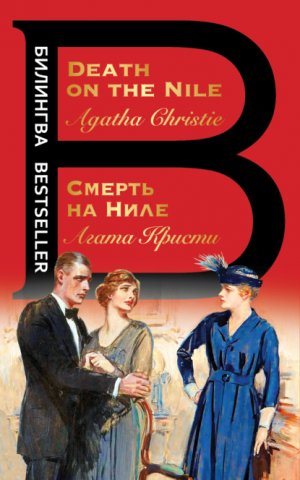
Ñìåðòü íà Íèëå / Death on the Nile Êðèñòè Àãàòà
‘How is your patient?’
‘Ach, he is going on splendidly. I have just reassured the Frulein de Bellefort. Would you believe it, I found her in despair. Just because the fellow had a bit of a temperature this afternoon! But what could be more natural? It is amazing that he is not in a high fever now. But no, he is like some of our peasants; he has a magnificent constitution, the constitution of an ox. I have seen them with deep wounds that they hardly notice. It is the same with Mr Doyle. His pulse is steady, his temperature only slightly above normal. I was able to pooh-pooh the little lady’s fears. All the same, it is ridiculous, nicht wahr? One minute you shoot a man, the next you are in hysterics in case he may not be doing well.’
Cornelia said: ‘She loves him terribly, you see.’
‘Ach! but it is not sensible, that. If you loved a man, would you try and shoot him? No, you are sensible.’
‘I don’t like things that go off with bangs anyway,’ said Cornelia.
‘Naturally you do not. You are very feminine.’
Race interrupted this scene of heavy approval.
‘Since Doyle is all right there’s no reason I shouldn’t come along and resume our talk of this afternoon. He was just telling me about a telegram.’
Dr Bessner’s bulk moved up and down appreciatively.
‘Ho, ho, ho, it was very funny that! Doyle, he tells me about it. It was a telegram all about vegetables – potatoes, artichokes, leeks – Ach! pardon?’
With a stifled exclamation, Race had sat up in his chair.
‘My God,’ he said. ‘So that’s it! Richetti!’
He looked round on three uncomprehending faces.
‘A new code – it was used in the South African rebellion. Potatoes mean machine guns, artichokes are high explosives – and so on. Richetti is no more an archologist than I am! He’s a very dangerous agitator, a man who’s killed more than once. And I’ll swear that he’s killed once again. Mrs Doyle opened that telegram by mistake, you see. If she were ever to repeat what was in it before me, he knew his goose would be cooked!’ He turned to Poirot. ‘Am I right?’ he asked. ‘Is Richetti the man?’
‘He is your man,’ said Poirot. ‘I always thought there was something wrong about him! He was almost too word-perfect in his role – he was all archologist, not enough human being.’ He paused and then said: ‘But it was not Richetti who killed Linnet Doyle. For some time now I have known what I may express as the “first half ” of the murderer. Now I know the “second half ” also. The picture is complete. But you understand that, although I know what must have happened, I have no proof that it happened. Intellectually the case is satisfying. Actually it is profoundly unsatisfactory. There is only one hope – a confession from the murderer.’
Dr Bessner raised his shoulders sceptically. ‘
Ah! but that – i would be a miracle.’
‘I think not. Not under the circumstances.’
Cornelia cried out:
‘But who is it? Aren’t you going to tell us?’
Poirot’s eyes ranged quietly over the three of them. Race, smiling sardonically, Bessner, still looking sceptical, Cornelia, her mouth hanging a little open, gazing at him with eager eyes.
‘Mais oui,’ he said. ‘I like an audience, I must confess. I am vain, you see. I am puffed up with conceit. I like to say, “See how clever is Hercule Poirot!” ’
Race shifted a little in his chair.
‘Well,’ he asked gently, ‘ just how clever is Hercule Poirot?’
Shaking his head sadly from side to side Poirot said:
‘To begin with I was stupid – incredibly stupid. To me the stumbling block was the pistol – Jacqueline de Bellefort’s pistol. Why had that pistol not been left on the scene of the crime? The idea of the murderer was quite plainly to incriminate her. Why then did the murderer take it away? I was so stupid that I thought of all sorts of fantastic reasons. The real one was very simple. The murderer took it away because he had to take it away – because he had no choice in the matter.’
Chapter 28
‘You and I, my friend,’ Poirot leaned towards Race, ‘started our investigation with a preconceived idea. That idea was that the crime was committed on the spur of the moment, without any preliminary planning. Somebody wished to remove Linnet Doyle and had seized their opportunity to do so at a moment when the crime would almost certainly be attributed to Jacqueline de Bellefort. It therefore followed that the person in question had overheard the scene between Jacqueline and Simon Doyle and had obtained possession of the pistol after the others had left the saloon.
‘But, my friends, if that preconceived idea was wrong, the whole aspect of the case altered. And it was wrong! This was no spontaneous crime committed on the spur of the moment. It was, on the contrary, very carefully planned and accurately timed, with all the details meticulously worked out beforehand, even to the drugging of Hercule Poirot’s bottle of wine on the night in question!
‘But yes, that is so! I was put to sleep so that there should be no possibility of my participating in the events of the night. It did just occur to me as a possibility. I drink wine; my two companions at table drink whisky and mineral water respectively. Nothing easier than to slip a dose of harmless narcotic into my bottle of wine – the bottles stand on the tables all day. But I dismissed the thought. It had been a hot day, I had been unusually tired – it was not really extraordinary that I should for once have slept heavily instead of lightly as I usually do.
‘You see, I was still in the grip of the preconceived idea. If I had been drugged, that would have implied premeditation, it would mean that before 7.30, when dinner is served, the crime had already been decided upon; and that (always from the point of view of the preconceived idea) was absurd. ‘The first blow to the preconceived idea was when the pistol was recovered from the Nile. To begin with, if we were right in our assumptions, the pistol ought never to have been thrown overboard at all … And there was more to follow.’ Poirot turned to Dr Bessner. ‘You, Dr Bessner, examined Linnet Doyle’s body. You will remember that the wound showed signs of scorching – that is to say, that the pistol had been placed close against the head before being fired.’
Bessner nodded.
‘So. That is exact.’
‘But when the pistol was found it was wrapped in a velvet stole, and that velvet showed definite signs that a pistol had been fired through its folds, presumably under the impression that that would deaden the sound of the shot. But if the pistol had been fired through the velvet, there would have been no signs of burning on the victim’s skin. Therefore, the shot fired through the stole could not have been the shot that killed Linnet Doyle. Could it have been the other shot – the one fired by Jacqueline de Bellefort at Simon Doyle? Again no, for there had been two witnesses of that shooting, and we knew all about it. It appeared, therefore, as though a third shot had been fired – one we knew nothing about. But only two shots had been fired from the pistol, and there was no hint or suggestion of another shot.
‘Here we were face to face with a very curious unexplained circumstance. The next interesting point was the fact that in Linnet Doyle’s cabin I found two bottles of coloured nail polish. Now ladies very often vary the colour of their nails, but so far Linnet Doyle’s nails had always been the shade called Cardinal – a deep dark red. The other bottle was labelled Rose, which is a shade of pale pink, but the few drops remaining in the bottle were not pale pink but a bright red. I was sufficiently curious to take out the stopper and sniff. Instead of the usual em odour of pear drops, the bottle smelt of vinegar! That is to say, it suggested that the drop or two of fluid in it was red ink. Now there is no reason why Madame Doyle should not have had a bottle of red ink, but it would have been more natural if she had had red ink in a red ink bottle and not in a nail polish bottle. It suggested a link with the faintly stained handkerchief which had been wrapped round the pistol. Red ink washes out quickly but always leaves a pale pink stain.
‘I should perhaps have arrived at the truth with these slender indications, but an event occurred which rendered all doubt superfluous. Louise Bourget was killed in circumstances which pointed unmistakably to the fact that she had been blackmailing the murderer. Not only was a fragment of a mille franc note still clasped in her hand, but I remembered some very significant words she had used this morning.
‘Listen carefully, for here is the crux of the whole matter. When I asked her if she had seen anything the previous night she gave this very curious answer: “Naturally, if I had been unable to sleep, if I had mounted the stairs, then perhaps I might have seen this assassin, this monster enter or leave Madame’s cabin…” Now what exactly did that tell us?’
Bessner, his nose wrinkling with intellectual interest, replied promptly:
‘It told you that she had mounted the stairs.’
‘No, no – you fail to see the point. Why should she have said that, to us?’
‘To convey a hint.’
‘But why hint to us? If she knows who the murderer is, there are two courses open to her – to tell us the truth, or to hold her tongue and demand money for her silence from the person concerned! But she does neither. She neither says promptly: “I saw nobody. I was asleep.” Nor does she say: “Yes, I saw someone, and it was so and so.” Why use that significant indeterminate rigmarole of words? Parbleu, there can be only one reason! She is hinting to the murderer; therefore the murderer must have been present at the time. But, besides myself and Colonel Race, only two people were present – Simon Doyle and Dr Bessner.’
The doctor sprang up with a roar.
‘Ach! what is that you say? You accuse me? Again? But it is ridiculous – beneath contempt.’
Poirot said sharply:
‘Be quiet. I am telling you what I thought at the time. Let us remain impersonal.’
‘He doesn’t mean he thinks it’s you now,’ said Cornelia soothingly.
Poirot went on quickly.
‘So it lay there – between Simon Doyle and Dr Bessner. But what reason has Bessner to kill Linnet Doyle? None, so far as I know. Simon Doyle, then? But that was impossible! There were plenty of witnesses who could swear that Doyle never left the saloon that evening until the quarrel broke out. After that he was wounded and it would then have been physically impossible for him to have done so. Had I good evidence on both those points? Yes, I had the evidence of Mademoiselle Robson, of Jim Fanthorp and of Jacqueline de Bellefort as to the first, and I had the skilled testimony of Dr Bessner and of Mademoiselle Bowers as to the other. No doubt was possible.
‘So Dr Bessner must be the guilty one. In favour of this theory there was the fact that the maid had been stabbed with a surgical knife. On the other hand Bessner had deliberately called attention to this fact.
‘And then, my friends, a second perfectly indisputable fact became apparent to me. Louise Bourget’s hint could not have been intended for Dr Bessner, because she could perfectly well have spoken to him in private at any time she liked. There was one person, and one person only, who corresponded to her necessity – Simon Doyle! Simon Doyle was wounded, was constantly attended by a doctor, was in that doctor’s cabin. It was to him therefore that she risked saying those ambiguous words in case she might not get another chance. And I remember how she had gone on, turning to him: “Monsieur, I implore you – you see how it is? What can I say?” And this answer: “My good girl, don’t be a fool. Nobody thinks you saw or heard anything. You’ll be quite all right. I’ll look after you. Nobody’s accusing you of anything.” That was the assurance she wanted, and she got it!’
Bessner uttered a colossal snort.
‘Ach! it is foolish, that! Do you think a man with a fractured bone and a splint on his leg could go walking about the boat and stabbing people? I tell you, it was impossible for Simon Doyle to leave his cabin.’
Poirot said gently:
‘I know. That is quite true. The thing was impossible. It was impossible – but it was also true! There could be only one logical meaning behind Louise Bourget’s words.
‘So I returned to the beginning and reviewed the crime in the light of this new knowledge. Was it possible that in the period preceding the quarrel Simon Doyle had left the saloon and the others had forgotten or not noticed it? I could not see that that was possible. Could the skilled testimony of Dr Bessner and Mademoiselle Bowers be disregarded? Again I felt sure it could not. But, I remembered, there was a gap between the two. Simon Doyle had been alone in the saloon for a period of five minutes, and the skilled testimony of Dr Bessner only applied to the time after that period. For that period we had only the evidence of visual appearance, and, though apparently that was perfectly sound, it was no longer certain. What had actually been seen – leaving assumption out of the question?
‘Mademoiselle Robson had seen Mademoiselle de Bellefort fire her pistol, had seen Simon Doyle collapse on to a chair, had seen him clasp a handkerchief to his leg and seen that handkerchief gradually soak through red. What had Monsieur Fanthorp heard and seen? He heard a shot, he found Doyle with a red-stained handkerchief clasped to his leg. What had happened then? Doyle had been very insistent that Mademoiselle de Bellefort should be got away, that she should not be left alone. After that, he suggested that Fanthorp should get hold of the doctor.
‘Accordingly Mademoiselle Robson and Monsieur Fanthorp got out with Mademoiselle de Bellefort and for the next five minutes they are busy, on the port side of the deck. Mademoiselle Bowers’, Dr Bessner’s and Mademoiselle de Bellefort’s cabins are all on the port side. Two minutes are all that Simon Doyle needs. He picks up the pistol from under the sofa, slips out of his shoes, runs like a hare silently along the starboard deck, enters his wife’s cabin, creeps up to her as she lies asleep, shoots her through the head, puts the bottle that has contained the red ink on her washstand (it mustn’t be found on him), runs back, gets hold of Mademoiselle Van Schuyler’s velvet stole, which he has quietly stuffed down the side of a chair in readiness, muffles it round the pistol and fires a bullet into his leg. His chair into which he falls (in genuine agony this time) is by a window. He lifts the window and throws the pistol (wrapped up with the tell-tale handkerchief in the velvet stole) into the Nile.’
‘Impossible!’ said Race.
‘No, my friend, not impossible. Remember the evidence of Tim Allerton. He heard a pop – followed by a splash. And he heard something else – the footsteps of a man running – a man running past his door. But nobody could have been running along the starboard side of the deck. What he heard was the stockinged feet of Simon Doyle running past his cabin.’
Race said: ‘I still say it’s impossible. No man could work out the whole caboodle like that in a flash – especially a chap like Doyle who is slow in his mental processes.’
‘But very quick and deft in his physical actions!’
‘That, yes. But he wouldn’t be capable of thinking the whole thing out.’
‘But he did not think it out himself, my friend. That is where we were all wrong. It looked like a crime committed on the spur of the moment, but it was not a crime committed on the spur of the moment. As I say, it was a very cleverly planned and well thought out piece of work. It could not be chance that Simon Doyle had a bottle of red ink in his pocket. No, it must be design. It was not chance that he had a plain unmarked handkerchief with him. It was not chance that Jacqueline de Bellefort’s foot kicked the pistol under the settee, where it would be out of sight and unremembered until later.’
‘Jacqueline?’
‘Certainly. The two halves of the murderer. What gave Simon his alibi? The shot fired by Jacqueline. What gave Jacqueline her alibi? The insistence of Simon which resulted in a hospital nurse remaining with her all night. There, between the two of them, you get all the qualities you require – the cool, resourceful, planning brain, Jacqueline de Bellefort’s brain, and the man of action to carry it out with incredible swiftness and timing.’
‘Look at it the right way, and it answers every question. Simon Doyle and Jacqueline had been lovers. Realize that they are still lovers, and it is all clear. Simon does away with his rich wife, inherits her money, and in due course will marry his old love. It was all very ingenious. The persecution of Madame Doyle by Jacqueline, all part of the plan. Simon’s pretended rage. And yet – there were lapses. He held forth to me once about possessive women – held forth with real bitterness. It ought to have been clear to me that it was his wife he was thinking about – not Jacqueline. Then his manner to his wife in public. An ordinary, inarticulate Englishman, such as Simon Doyle, is very embarrassed at showing any affection. Simon was not a really good actor. He overdid the devoted manner. That conversation I had with Mademoiselle Jacqueline, too, when she pretended that somebody had overheard, I saw no one. And there was no one! But it was to be a useful red herring later. Then one night on this boat I thought I heard Simon and Linnet outside my cabin. He was saying, “We’ve got to go through with it now.” It was Doyle all right, but it was to Jacqueline he was speaking.
‘The final drama was perfectly planned and timed. There was a sleeping draught for me, in case I might put an inconvenient finger in the pie. There was the selection of Mademoiselle Robson as a witness – the working up of the scene, Mademoiselle de Bellefort’s exaggerated remorse and hysterics. She made a good deal of noise, in case the shot should be heard. En vrit, it was an extraordinarily clever idea. Jacqueline says she has shot Doyle, Mademoiselle Robson says so, Fanthorp says so – and when Simon’s leg is examined he has been shot. It looks unanswerable! For both of them there is a perfect alibi – at the cost, it is true, of a certain amount of pain and risk to Simon Doyle, but it is necessary that his wound should definiely disable him.
‘And then the plan goes wrong. Louise Bourget has been wakeful. She has come up the stairway and she has seen Simon Doyle run along to his wife’s cabin and come back. Easy enough to piece together what has happened the following day. And so she makes her greedy bid for hush money, and in so doing signs her death warrant.’
‘But Mr Doyle couldn’t have killed her?’ Cornelia objected.
‘No, the other partner did that murder. As soon as he can, Simon Doyle asks to see Jacqueline. He even asks me to leave them alone together. He tells her then of the new danger. They must act at once. He knows where Bessner’s scalpels are kept. After the crime the scalpel is wiped and returned, and then, very late and rather out of breath, Jacqueline de Bellefort hurries in to lunch.
‘And still all is not well. For Madame Otterbourne has seen Jacqueline go into Louise Bourget’s cabin. And she comes hot-foot to tell Simon about it. Jacqueline is the murderess. Do you remember how Simon shouted at the poor woman? Nerves, we thought. But the door was open and he was trying to convey the danger to his accomplice. She heard and she acted – acted like lightning. She remembered Pennington had talked about a revolver. She got hold of it, crept up outside the door, listened and, at the critical moment, fired. She boasted once that she was a good shot, and her boast was not an idle one.
‘I remarked after that third crime that there were three ways the murderer could have gone. I meant that he could have gone aft (in which case Tim Allerton was the criminal), he could have gone over the side (very improbable) or he could have gone into a cabin. Jacqueline’s cabin was just two away from Dr Bessner’s. She had only to throw down the revolver, bolt into the cabin, ruffle her hair and fling herself down on the bunk. It was risky, but it was the only possible chance.’
There was a silence, then Race asked:
‘What happened to the first bullet fired at Doyle by the girl?’
‘I think it went into the table. There is a recently made hole there. I think Doyle had time to dig it out with a penknife and fling it through the window. He had, of course, a spare cartridge, so that it would appear that only two shots had been fired.’
Cornelia sighed.
‘They thought of everything,’ she said. ‘It’s – horrible!’
Poirot was silent. But it was not a modest silence. His eyes seemed to be saying: ‘You are wrong. They didn’t allow for Hercule Poirot.’
Aloud he said,
‘And now, Doctor, we will go and have a word with your patient…’
Chapter 29
It was very much later that evening that Hercule Poirot came and knocked on the door of a cabin. A voice said ‘Come in’ and he entered.
Jacqueline de Bellefort was sitting in a chair. In another chair, close against the wall, sat the big stewardess. Jacqueline’s eyes surveyed Poirot thoughtfully. She made a gesture towards the stewardess.
‘Can she go?’
Poirot nodded to the woman and she went out. Poirot drew up her chair and sat down near Jacqueline. Neither of them spoke. Poirot’s face was unhappy.
In the end it was the girl who spoke first.
‘Well,’ she said, ‘it is all over! You were too clever for us, Monsieur Poirot.’
Poirot sighed. He spread out his hands. He seemed strangely dumb.
‘All the same,’ said Jacqueline reflectively, ‘I can’t really see that you had much proof. You were quite right, of course, but if we’d bluffed you out-’
‘In no other way, Mademoiselle, could the thing have happened.’
‘That’s proof enough for a logical mind, but I don’t believe it would have convinced a jury. Oh, well – it can’t be helped. You sprang it all on Simon, and he went down like a ninepin. He just lost his head utterly, poor lamb, and admitted everything.’ She shook her head. ‘He’s a bad loser.’
‘But you, Mademoiselle, are a good loser.’
She laughed suddenly – a queer, gay, defiant little laugh.
‘Oh, yes, I’m a good loser all right.’ She looked at him. She said suddenly and impulsively: ‘Don’t mind so much, Monsieur Poirot! About me, I mean. You do mind, don’t you?’
‘Yes, Mademoiselle.’
‘But it wouldn’t have occurred to you to let me off?’
Hercule Poirot said quietly,
‘No.’
She nodded her head in quiet agreement.
‘No, it’s no use being sentimental. I might do it again… I’m not a safe person any longer. I can feel that myself…’ She went on broodingly: ‘It’s so dreadfully easy – killing people. And you begin to feel that it doesn’t matter… that it’s only you that matters! It’s dangerous – that.’ She paused, then said with a little smile: ‘You did your best for me, you know. That night at Aswan – you told me not to open my heart to evil… Did you realize then what was in my mind?’
He shook his head.
‘I only knew that what I said was true.’
‘It was true… I could have stopped, then, you know. I nearly did… I could have told Simon that I wouldn’t go on with it… But then perhaps-’ She broke off. She said: ‘Would you like to hear about it? From the beginning?’
‘If you care to tell me, Mademoiselle.’
‘I think I want to tell you. It was all very simple really. You see, Simon and I loved each other…’
It was a matter-of-fact statement, yet, underneath the lightness of her tone, there were echoes…
Poirot said simply: ‘And for you love would have been enough, but not for him.’
‘You might put it that way, perhaps. But you don’t quite understand Simon. You see, he’s always wanted money so dreadfully. He liked all the things you get with money – horses and yachts and sport – nice things all of them, things a man ought to be keen about. And he’d never been able to have any of them. He’s awfully simple, Simon is. He wants things just as a child wants them – you know – terribly.
‘All the same he never tried to marry anybody rich and horrid. He wasn’t that sort. And then we met – and – and that sort of settled things. Only we didn’t see when we’d be able to marry. He’d had rather a decent job, but he’d lost it. In a way it was his own fault. He tried to do something smart over money and got found out at once. I don’t believe he really meant to be dishonest. He just thought it was the sort of thing people did in the City.’
A flicker passed over her listener’s face, but he guarded his tongue.
‘There we were, up against it; and then I thought of Linnet and her new country house, and I rushed off to her. You know, Monsieur Poirot, I loved Linnet, really I did. She was my best friend, and I never dreamed that anything would ever come between us. I just thought how lucky it was she was rich. It might make all the difference to me and Simon if she’d give him a job. And she was awfully sweet about it and told me to bring Simon down to see her. It was about then you saw us that night at Chez Ma Tante. We were making whoopee, although we couldn’t really afford it.’
She paused, sighed, then went on.
‘What I’m going to say now is quite true, Monsieur Poirot. Even though Linnet is dead, it doesn’t alter the truth. That’s why I’m not really sorry about her, even now. She went all out to get Simon away from me. That’s the absolute truth! I don’t think she even hesitated for more than about a minute. I was her friend, but she didn’t care. She just went bald-headed for Simon…
‘And Simon didn’t care a damn about her! I talked a lot to you about glamour, but of course that wasn’t true. He didn’t want Linnet. He thought her good-looking but terribly bossy, and he hated bossy women! The whole thing embarrassed him frightfully. But he did like the thought of her money.
‘Of course I saw that… And at last I suggested to him that it might be a good thing if he – got rid of me and married Linnet. But he scouted the idea. He said, money or no money, it would be hell to be married to her. He said his idea of having money was to have it himself – not to have a rich wife holding the purse strings. “I’d be a kind of damned Prince Consort,” he said to me. He said, too, that he didn’t want anyone but me…
‘I think I know when the idea came into his head. He said one day: “If I’d any luck, I’d marry her and she’d die in about a year and leave me all the boodle.” And then a queer startled look came into his eyes. That was when he first thought of it…
‘He talked about it a good deal, one way and another – about how convenient it would be if Linnet died. I said it was an awful idea, and then he shut up about it. Then, one day, I found him reading up all about arsenic. I taxed him with it then, and he laughed and said: “Nothing venture, nothing have! It’s about the only time in my life I shall be near to touching a far lot of money.”
‘After a bit I saw that he’d made up his mind. And I was terrified – simply terrified. Because, you see, I realized that he’d never pull it off. He’s so childishly simple. He’d have no kind of subtlety about it – and he’s got no imagination. He would probably have just bunged arsenic into her and assumed the doctor would say she’d died of gastritis. He always thought things would go right. ‘So I had to come into it, too, to look after him…’
She said it very simply but in complete good faith. Poirot had no doubt whatever that her motive had been exactly what she said it was. She herself had not coveted Linnet Ridgeway’s money, but she had loved Simon Doyle, had loved him beyond reason and beyond rectitude and beyond pity.
‘I thought and I thought – trying to work out a plan. It seemed to me that the basis of the idea ought to be a kind of two-handed alibi. You know – if Simon and I could somehow or other give evidence against each other, but actually that evidence would clear us of everything. It would be easy enough for me to pretend to hate Simon. It was quite a likely thing to happen under the circumstances. Then, if Linnet was killed, I should probably be suspected, so it would be better if I was suspected right away. We worked out details little by little. I wanted it to be so that if anything went wrong, they’d get me and not Simon. But Simon was worried about me.
‘The only thing I was glad about was that I hadn’t got to do it. I simply couldn’t have! Not go along in cold blood and kill her when she was asleep! You see, I hadn’t forgiven her – I think I could have killed her face to face, but not the other way…
‘We worked everything out carefully. Even then, Simon went and wrote a J in blood which was a silly melodramatic thing to do. It’s just the sort of thing he would think of! But it went off all right.’
Poirot nodded.
‘Yes. It was not your fault that Louise Bourget could not sleep that night… And afterwards, Mademoiselle?’
She met his eyes squarely.
‘Yes,’ she said ‘it’s rather horrible isn’t it? I can’t believe that I – did that! I know now what you meant by opening your heart to evil… You know pretty well how it happened. Louise made it clear to Simon that she knew. Simon got you to bring me to him. As soon as we were alone together he told me what had happened. He told me what I’d got to do. I wasn’t even horrified. I was so afraid – so deadly afraid… That’s what murder does to you… Simon and I were safe – quite safe – except for this miserable blackmailing French girl. I took her all the money we could get hold of. I pretended to grovel. And then, when she was counting the money, I – did it! It was quite easy. That’s what’s so horribly, horribly frightening about it… It’s so terribly easy…
‘And even then we weren’t safe. Mrs Otterbourne had seen me. She came triumphantly along the deck looking for you and Colonel Race. I’d no time to think. I just acted like a flash. It was almost exciting. I knew it was touch or go that time. That seemed to make it better…’
She stopped again.
‘Do you remember when you came into my cabin afterwards? You said you were not sure why you had come. I was so miserable – so terrified. I thought Simon was going to die…’
‘And I – was hoping it,’ said Poirot.
Jacqueline nodded.
‘Yes, it would have been better for him that way.’
‘That was not my thought.’
Jacqueline looked at the sternness of his face. She said gently:
‘Don’t mind so much for me, Monsieur Poirot. After all, I’ve lived hard always, you know. If we’d won out, I’d have been very happy and enjoyed things and probably should never have regretted anything. As it is – well, one goes through with it.’ She added: ‘I suppose the stewardess is in attendance to see I don’t hang myself or swallow a miraculous capsule of prussic acid as people always do in books. You needn’t be afraid! I shan’t do that. It will be easier for Simon if I’m standing by.’
Poirot got up. Jacqueline rose also. She said with a sudden smile:
‘Do you remember when I said I must follow my star? You said it might be a false star. And I said: “That very bad star, that star fall down.” ’
He went out to the deck with her laughter ringing in his ears.
Chapter 30
It was early dawn when they came into Shellal. The rocks came down grimly to the water’s edge. Poirot murmured:
‘Quel pays sauvage!’
Race stood beside him.
‘Well,’ he said, ‘we’ve done our job. I’ve arranged for Richetti to be taken ashore first. Glad we’ve got him. He’s been a slippery customer, I can tell you. Given us the slip dozens of times.’ He went on: ‘We must get hold of a stretcher for Doyle. Remarkable how he went to pieces.’
‘Not really,’ said Poirot. ‘That boyish type of criminal is usually intensely vain. Once prick the bubble of their self-esteem and it is finished! They go to pieces like children.’
‘Deserves to be hanged,’ said Race. ‘He’s a coldblooded scoundrel. I’m sorry for the girl – but there’s nothing to be done about it.’
Poirot shook his head.
‘People say love justifies everything, but that is not true… Women who care for men as Jacqueline cares for Simon Doyle are very dangerous. It is what I said when I saw her first. “She cares too much, that little one!” It is true.’
Cornelia Robson came up beside him.
‘Oh,’ she said, ‘we’re nearly in.’ She paused a minute or two, then added, ‘I’ve been with her.’
‘With Mademoiselle de Bellefort?’
‘Yes. I felt it was kind of awful for her boxed up with that stewardess. Cousin Marie’s very angry, though, I’m afraid.’
Miss Van Schuyler was progressing slowly down the deck towards them. Her eyes were venomous.
‘Cornelia,’ she snapped, ‘you’ve behaved outrageously. I shall send you straight home.’
Cornelia took a deep breath.
‘I’m sorry, Cousin Marie, but I’m not going home. I’m going to get married.’
‘So you’ve seen sense at last,’ snapped the old lady.
Ferguson came striding round the corner of the deck.
He said: ‘Cornelia, what’s this I hear? It’s not true!’
‘It’s quite true,’ said Cornelia. ‘I’m going to marry Dr Bessner. He asked me last night.’
‘And why are you going to marry him?’ said Ferguson furiously. ‘Simply because he’s rich?’
‘No, I’m not,’ said Cornelia indignantly. ‘I like him. He’s kind, and he knows a lot. And I’ve always been interested in sick folks and clinics, and I shall have just a wonderful life with him.’
‘Do you mean to say,’ said Mr Ferguson incredulously, ‘that you’d rather marry that disgusting old man than me?’
‘Yes, I would. You’re not reliable! You wouldn’t be at all a comfortable sort of person to live with. And he’s not old. He’s not fifty yet.’
‘He’s got a stomach,’ said Mr Ferguson venomously.
‘Well, I’ve got round shoulders,’ retorted Cornelia. ‘What one looks like doesn’t matter. He says I really could help him in his work, and he’s going to teach me all about neuroses.’
She moved away.
Ferguson said to Poirot: ‘Do you think she really means that?’
‘Certainly.’
‘She prefers that pompous old bore to me?’
‘Undoubtedly.’
‘The girl’s mad,’ declared Ferguson.
Poirot’s eyes twinkled.
‘She is a woman of an original mind,’ he said. ‘It is probably the first time you have met one.’
The boat drew in to the landing stage. A cordon had been drawn round the passengers. They had been asked to wait before disembarking. Richetti, dark-faced and sullen, was marched ashore by two engineers. Then, after a certain amount of delay, a stretcher was brought. Simon Doyle was carried along the deck to the gangway. He looked a different man – cringing, frightened, all his boyish insouciance vanished. Jacqueline de Bellefort followed. A stewardess walked beside her. She was pale but otherwise looked much as usual. She came up to the stretcher.
‘Hallo, Simon!’ she said.
He looked up at her quickly. The old boyish look came back to his face for a moment.
‘I messed it up,’ he said. ‘Lost my head and admitted everything! Sorry, Jackie. I’ve let you down.’
She smiled at him then. ‘It’s all right, Simon,’ she said. ‘A fool’s game, and we’ve lost. That’s all.’
She stood aside. The bearers picked up the handles of the stretcher. Jacqueline bent down and tied the lace of her shoe. Then her hand went to her stocking top and she straightened up with something in her hand. There was a sharp explosive pop. Simon Doyle gave one convulsed shudder and then lay still. Jacqueline de Bellefort nodded. She stood for a minute, pistol in hand. She gave a fleeting smile at Poirot. Then, as Race jumped forward, she turned the little glittering toy against her heart and pressed the trigger. She sank down in a soft huddled heap.
Race shouted: ‘Where the devil did she get that pistol?’
Poirot felt a hand on his arm. Mrs Allerton said softly,
‘You – knew?’
He nodded.
‘She had a pair of these pistols. I realized that when I heard that one had been found in Rosalie Otterbourne’s handbag the day of the search. Jacqueline sat at the same table as they did. When she realized that there was going to be a search, she slipped it into the other girl’s handbag. Later she went to Rosalie’s cabin and got it back, after having distracted her attention with a comparison of lipsticks. As both she and her cabin had been searched yesterday, it wasn’t thought necessary to do it again.’
Mrs Allerton said: ‘You wanted her to take that way out?’
‘Yes. But she would not take it alone. That is why Simon Doyle has died an easier death than he deserved.’
Mrs Allerton shivered.
‘Love can be a very frightening thing.’
‘That is why most great love stories are tragedies.’
Mrs Allerton’s eyes rested upon Tim and Rosalie, standing side by side in the sunlight, and she said suddenly and passionately:
‘But thank God, there is happiness in the world.’
‘As you say, Madame, thank God for it.’
Presently the passengers went ashore.
Later the bodies of Louise Bourget and Mrs Otterbourne were carried off the Karnak.
Lastly the body of Linnet Doyle was brought ashore, and all over the world wires began to hum, telling the public that Linnet Doyle, who had been Linnet Ridgeway, the famous, the beautiful, the wealthy Linnet Doyle was dead.
Sir George Wode read about it in his London club, and Sterndale Rockford in New York, and Joanna Southwood in Switzerland, and it was discussed in the bar of the Three Crowns in Malton-under-Wode.
And Mr Burnaby’s lean friend said:
‘Well, it didn’t seem fair, her having everything.’
And Mr Burnaby said acutely: