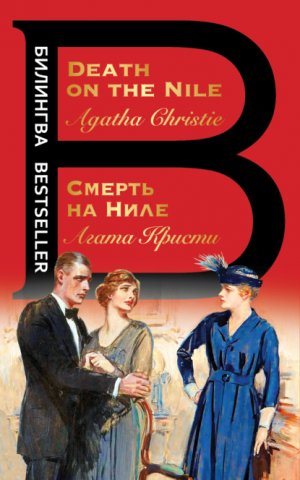
Смерть на Ниле / Death on the Nile Кристи Агата
‘It will be simpler to say who it could not have been. Neither Monsieur Doyle, Madame Allerton, Monsieur Tim Allerton, Mademoiselle Van Schuyler nor Mademoiselle Bowers could have had anything to do with it. They were all within my sight.’
‘H’m,’ said Race, ‘that leaves rather a large field. What about motive?
‘That is where I hope Monsieur Doyle may be able to help us. There have been several incidents-’
The door opened and Jacqueline de Bellefort entered. She was very pale and she stumbled a little as she walked.
‘I didn’t do it,’ she said. Her voice was that of a frightened child. ‘I didn’t do it. Oh, please believe me. Everyone will think I did it – but I didn’t – I didn’t. It’s – it’s awful. I wish it hadn’t happened. I might have killed Simon last night – I was mad, I think. But I didn’t do the other…’
She sat down and burst into tears.
Poirot patted her on the shoulder.
‘There, there. We know that you did not kill Madame Doyle. It is proved – yes, proved, mon enfant. It was not you.’
Jackie sat up suddenly, her wet handkerchief clasped in her hand.
‘But who did?’
‘That,’ said Poirot, ‘is just the question we are asking ourselves. You cannot help us there, my child?’
Jacqueline shook her head.
‘I don’t know… I can’t imagine… No, I haven’t the faintest idea.’
She frowned deeply. ‘No,’ she said at last. ‘I can’t think of anyone who wanted her dead’-her voice faltered a little-‘except me.’
Race said:
‘Excuse me a minute – just thought of something.’ He hurried out of the room.
Jacqueline de Bellefort sat with her head downcast, nervously twisting her fingers. She broke out suddenly:
‘Death’s horrible – horrible! I – hate the thought of it.’
Poirot said:
‘Yes. It is not pleasant to think, is it, that now, at this very moment, someone is rejoicing at the successful carrying out of his or her plan.’
‘Don’t – don’t!’ cried Jackie. ‘It sounds horrible, the way you put it.’
Poirot shrugged his shoulders.
‘It is true.’
Jackie said in a low voice:
‘I–I wanted her dead – and she is dead… And, what is worse… she died – just like I said.’
‘Yes, Mademoiselle. She was shot through the head.’
She cried out:
‘Then I was right, that night at the Cataract Hotel. There was someone listening!’
‘Ah!’ Poirot nodded his head. ‘I wondered if you would remember that. Yes, it is altogether too much of a coincidence – that Madame Doyle should be killed in just the way you described.’
Jackie shuddered.
‘That man that night – who can he have been?’
Poirot was silent for a minute or two, then he said in quite a different tone of voice:
‘You are sure it was a man, Mademoiselle?’
Jackie looked at him in surprise.
‘Yes, of course. At least-’
‘Well, Mademoiselle?’
She frowned, half closing her eyes in an effort to remember. She said slowly:
‘I thought it was a man…’
‘But now you are not so sure?’
Jackie said slowly:
‘No, I can’t be certain. I just assumed it was a man – but it was really just a – a figure – a shadow…’
She paused and then, as Poirot did not speak, she added:
‘You think it must have been a woman? But surely none of the women on this boat can have wanted to kill Linnet?’
Poirot merely moved his head from side to side.
The door opened and Bessner appeared.
‘Will you come and speak with Mr Doyle, please, Monsieur Poirot? He would like to see you.’
Jackie sprang up. She caught Bessner by the arm.
‘How is he? Is he – all right?’
‘Naturally he is not all right,’ replied Dr Bessner reproachfully. ‘The bone is fractured, you understand.’
‘But he’s not going to die?’ cried Jackie.
‘Ach, who said anything about dying? We will get him to civilization and there we will have an X-ray and proper treatment.’
‘Oh!’ The girl’s hands came together in a convulsive pressure. She sank down again on a chair.
Poirot stepped out on to the deck with the doctor and at that moment Race joined them. They went up to the promenade deck and along to Bessner’s cabin.
Simon Doyle was lying propped with cushions and pillows, an improvised cage over his leg. His face was ghastly in colour, the ravages of pain with shock on top of it. But the predominant expression on his face was bewilderment – the sick bewilderment of a child.
He muttered:
‘Please come in. The doctor’s told me – told me – about Linnet… I can’t believe it. I simply can’t believe it’s true.’
‘I know. It’s a bad knock,’ said Race.
Simon stammered:
‘You know – Jackie didn’t do it. I’m certain Jackie didn’t do it! It looks black against her, I dare say, but she didn’t do it. She – she was a bit tight last night, and all worked up, and that’s why she went for me. But she wouldn’t – she wouldn’t do murder … not cold-blooded murder…’
Poirot said gently:
‘Do not distress yourself, Monsieur Doyle. Whoever shot your wife, it was not Mademoiselle de Bellefort.’
Simon looked at him doubtfully.
‘Is that on the level?’
‘But since it was not Mademoiselle de Bellefort,’ continued Poirot, ‘can you give us any idea of who it might have been?’
Simon shook his head. The look of bewilderment increased.
‘It’s crazy – impossible. Apart from Jackie nobody could have wanted to do her in.’
‘Reflect, Monsieur Doyle. Had she no enemies? Is there no one who had a grudge against her?’
Again Simon shook his head with the same hopeless gesture.
‘It sounds absolutely fantastic. There’s Windlesham, of course. She more or less chucked him to marry me – but I can’t see a polite stick like Windlesham committing murder, and anyway he’s miles away. Same thing with old Sir George Wode. He’d got a down on Linnet over the house – disliked the way she was pulling it about; but he’s miles away in London, and anyway to think of murder in such a connection would be fantastic.’
‘Listen, Monsieur Doyle.’ Poirot spoke very earnestly. ‘On the first day we came on board the Karnak I was impressed by a little conversation which I had with Madame your wife. She was very upset – very distraught. She said – mark this well – that everybody hated her. She said she felt afraid – unsafe – as though everyone round her were an enemy.’
‘She was pretty upset at finding Jackie aboard. So was I,’ said Simon.
‘That is true, but it does not quite explain those words. When she said she was surrounded by enemies, she was almost certainly exaggerating, but all the same she did mean more than one person.’
‘You might be right there,’ admitted Simon. ‘I think I can explain that. It was a name in the passenger list that upset her.’
‘A name in the passenger list? What name?’
‘Well, you see, she didn’t actually tell me. As a matter of fact I wasn’t even listening very carefully. I was going over the Jacqueline business in my mind. As far as I remember, Linnet said something about doing people down in business, and that it made her uncomfortable to meet anyone who had a grudge against her family. You see, although I don’t really know the family history very well, I gather that Linnet’s mother was a millionaire’s daughter. Her father was only just ordinary plain wealthy, but after his marriage he naturally began playing the markets or whatever you call it. And as a result of that, of course, several people got it in the neck. You know, affluence one day, the gutter the next. Well, I gather there was someone on board whose father had got up against Linnet’s father and taken a pretty hard knock. I remember Linnet saying: “It’s pretty awful when people hate you without even knowing you.” ’
‘Yes,’ said Poirot thoughtfully. ‘That would explain what she said to me. For the first time she was feeling the burden of her inheritance and not its advantages. You are quite sure, Monsieur Doyle, that she did not mention this man’s name?’
Simon shook his head ruefully.
‘I didn’t really pay much attention. Just said: “Oh, nobody minds what happened to their fathers nowadays. Life goes too fast for that.” Something of that kind.’
Bessner said dryly:
‘Ach, but I can have a guess. There is certainly a young man with a grievance on board.’
‘You mean Ferguson?’ said Poirot.
‘Yes. He spoke against Mrs Doyle once or twice. I myself have heard him.’
‘What can we do to find out?’ asked Simon.
Poirot replied: ‘Colonel Race and I must interview all the passengers. Until we have got their stories it would be unwise to form theories. Then there is the maid. We ought to interview her first of all. It would, perhaps, be as well if we did that here. Monsieur Doyle’s presence might be helpful.’
‘Yes, that’s a good idea,’ said Simon.
‘Had she been with Mrs Doyle long?’
‘Just a couple of months, that’s all.’
‘Only a couple of months!’ exclaimed Poirot.
‘Why, you don’t think-’
‘Had Madame any valuable jewellery?’
‘There were her pearls,’ said Simon. ‘She once told me they were worth forty or fifty thousand.’ He shivered. ‘My God, do you think those damned pearls-?’
‘Robbery is a possible motive,’ said Poirot. ‘All the same it seems hardly credible… Well, we shall see. Let us have the maid here.’
Louise Bourget was that same vivacious Latin brunette who Poirot had seen one day and noticed.
She was anything but vivacious now. She had been crying and looked frightened. Yet there was a kind of sharp cunning apparent in her face which did not prepossess the two men favourably towards her.
‘You are Louise Bourget?’
‘Yes, Monsieur.’
‘When did you last see Madame Doyle alive?’
‘Last night, Monsieur. I was in her cabin to undress her.’
‘What time was that?’
‘It was some time after eleven, Monsieur. I cannot say exactly when. I undress Madame and put her to bed, and then I leave.’
‘How long did all that take?’
‘Ten minutes, Monsieur. Madame was tired. She told me to put the lights out when I went.’
‘And when you had left her, what did you do?’
‘I went to my own cabin, Monsieur, on the deck below.’
‘And you heard or saw nothing more that can help us?’
‘How could I, Monsieur?’
‘That, Mademoiselle, is for you to say, not for us,’ Hercule Poirot retorted.
She stole a sideways glance at him.
‘But, Monsieur, I was nowhere near… What could I have seen or heard? I was on the deck below. My cabin, it was on the other side of the boat, even. It is impossible that I should have heard anything. Naturally if I had been unable to sleep, if I had mounted the stairs, then perhaps I might have seen the assassin, this monster, enter or leave Madame’s cabin, but as it is-’ She threw out her hands appealingly to Simon. ‘Monsieur, I implore you – you see how it is? What can I say?’
‘My good girl,’ said Simon harshly, ‘don’t be a fool. Nobody thinks you saw or heard anything. You’ll be quite all right. I’ll look after you. Nobody’s accusing you of anything.’
Louise murmured,
‘Monsieur is very good,’ and dropped her eyelids modestly.
‘We take it, then, that you saw and heard nothing?’ asked Race impatiently.
‘That is what I said, Monsieur.’
‘And you know of no one who had a grudge against your mistress?’
To the surprise of the listeners Louise nodded her head vigorously.
‘Oh, yes. That I do know. To that question I can answer Yes most emphatically.’
Poirot said:
‘You mean Mademoiselle de Bellefort?’
‘She, certainly. But it is not of her I speak. There was someone else on this boat who disliked Madame, who was very angry because of the way Madame had injured him.’
‘Good lord!’ Simon exclaimed. ‘What’s all this?’
Louise went on, still emphatically nodding her head with the utmost vigour.
‘Yes, yes, yes, it is as I say! It concerns the former maid of Madame – my predecessor. There was a man, one of the engineers on this boat, who wanted her to marry him. And my predecessor, Marie her name was, she would have done so. But Madame Doyle, she made enquiries and she discovered that this Fleetwood already he had a wife – a wife of colour, you understand, a wife of this country. She had gone back to her own people, but he was still married to her, you understand. And so Madame she told all this to Marie, and Marie she was very unhappy and she would not see Fleetwood any more. And this Fleetwood, he was infuriated, and when he found out that this Madame Doyle had formerly been Mademoiselle Linnet Ridgeway he tells me that he would like to kill her! Her interference ruined his life, he said.’
Louise paused triumphantly.
‘This is interesting,’ said Race.
Poirot turned to Simon.
‘Had you any idea of this?’
‘None whatever,’ Simon replied with patent sincerity. ‘I doubt if Linnet even knew the man was on the boat. She had probably forgotten all about the incident.’ He turned sharply to the maid. ‘Did you say anything to Mrs Doyle about this?’
‘No, Monsieur, of course not.’
Poirot said:
‘Do you know anything about your mistress’s pearls?’
‘Her pearls? Louise’s eyes opened very wide. ‘She was wearing them last night.’
‘You saw them when she came to bed?’
‘Yes, Monsieur.’
‘Where did she put them?’
‘On the table by the side as always.’
‘That is where you last saw them?’
‘Yes, Monsieur.’
‘Did you see them there this morning?’
A startled look came into the girl’s face.
‘Mon Dieu! I did not even look. I come up to the bed, I see – I see Madame, and then I cry out and rush out of the door and I faint.’
Hercule Poirot nodded his head.
‘You did not look. But I, I have the eyes which notice, and there were no pearls on the table beside the bed this morning.’
Chapter 14
Hercule Poirot’s observation had not been at fault. There were no pearls on the table by Linnet Doyle’s bed.
Louise Bourget was bidden to make a search among Linnet’s belongings. According to her, all was in order. Only the pearls had disappeared.
As they emerged from the cabin a steward was waiting to tell them that breakfast had been served in the smoking room.
As they passed along the deck, Race paused to look over the rail.
‘Aha! I see you have had an idea, my friend.’
‘Yes. It suddenly came to me, when Fanthorp mentioned thinking he had heard a splash that I too had been awakened some time last night by a splash. It’s perfectly possible that after the murder, the murderer threw the pistol overboard.’
Poirot said slowly: ‘You really think that is possible, my friend?’
Race shrugged his shoulders.
‘It’s a suggestion. After all, the pistol wasn’t any where in the cabin. First thing I looked for.’
‘All the same,’ said Poirot, ‘it is incredible that it should have been thrown overboard.’
Race said: ‘Where is it then?’
Poirot said thoughtfully:
‘If it is not in Madame Doyle’s cabin, there is, logically, only one other place where it could be.’
‘Where’s that?’
‘In Mademoiselle de Bellefort’s cabin.’
Race said thoughtfully: ‘Yes. I see-’
He stopped suddenly.
‘She’s out of her cabin. Shall we go and have a look now?’
Poirot shook his head.
‘No, my friend, that would be precipitate. It may not yet have been put there.’
‘What about an immediate search of the whole boat.’
‘That way we should show our hand. We must work with great care. It is very delicate, our position at the moment. Let us discuss the situation as we eat.’
Race agreed. They went into the smoking room.
‘Well?’ said Race as he poured himself out a cup of coffee. ‘We’ve got two definite leads. There’s the disappearance of the pearls. And there’s the man Fleetwood. As regards the pearls, robbery seems indicated, but – I don’t know whether you’ll agree with me-’
Poirot said quickly: ‘But it was an odd moment to choose?’
‘Exactly. To steal the pearls at such a moment invites a close search of everybody on board. How then could the thief hope to get away with his booty?’
‘He might have gone ashore and dumped it.’
‘The company always has a watchman on the bank.’
‘Then that is not feasible. Was the murder committed to divert attention from the robbery? No, that does not make sense – it is profoundly unsatisfactory. But supposing that Madame Doyle woke up and caught the thief in the act?’
‘And therefore the thief shot her? But she was shot whilst she slept.’
‘So that too does not make sense… You know, I have a little idea about those pearls – and yet – no – it is impossible. Because if my idea was right the pearls would not have disappeared. Tell me, what did you think of the maid?’
‘I wondered,’ said Race slowly, ‘if she knew more than she said.’
‘Ah, you too had that impression?’
‘Definitely not a nice girl,’ said Race.
Hercule Poirot nodded.
‘Yes, I would not trust her, that one.’
‘You think she had something to do with the murder?’
‘No, I would not say that.’
‘With the theft of the pearls, then?’
‘That is more probable. She had only been with Madame Doyle a very short time. She may be a member of a gang that specializes in jewel robberies. In such a case there is often a maid with excellent references. Unfortunately we are not in a position to seek information on these points. And yet that explanation does not quite satisfy me… Those pearls – ah, sacr, my little idea ought to be right. And yet nobody would be so imbecile-’ He broke off.
‘What about the man Fleetwood?’
‘We must question him. It may be that we have there the solution. If Louise Bourget’s story is true, he had a definite motive for revenge. He could have overheard the scene between Jacqueline and Monsieur Doyle, and when they had left the saloon he could have darted in and secured the gun. Yes, it is all quite possible. And that letter J scrawled in blood. That, too, would accord with a simple, rather crude nature.’
‘In fact, he’s just the person we are looking for?’
‘Yes – only-’ Poirot rubbed his nose. He said with a slight grimace: ‘See you, I recognize my own weaknesses. It has been said of me that I like to make a case difficult. This solution that you put to me – it is too simple, too easy. I cannot feel that it really happened. And yet, that may be sheer prejudice on my part.’
‘Well, we’d better have the fellow here.’
Race rang the bell and gave the order. Then he said:
‘Any other – possibilities?’
‘Plenty, my friend. There is, for example, the American trustee.’
‘Pennington?’
‘Yes, Pennington. There was a curious little scene in here the other day.’ He narrated the happenings to Race. ‘You see – it is significant. Madame, she wanted to read all the papers before signing. So he makes the excuse of another day. And then, the husband, he makes a very significant remark.’
‘What was that?’
‘He says-“I never read anything. I sign where I am told to sign.” You perceive the significance of that. Pennington did. I saw it in his eye. He looked at Doyle as though an entirely new idea had come into his head. Just imagine, my friend, that you have been left trustee to the daughter of an intensely wealthy man. You use, perhaps, that money to speculate with. I know it is so in all detective novels – but you read of it too in the newspapers. It happens, my friend, it happens.’
‘I don’t dispute it,’ said Race.
‘There is, perhaps, still time to make good by speculating wildly. Your ward is not yet of age. And then – she marries! The control passes from your hands into hers at a moment’s notice! A disaster! But there is still a chance. She is on a honeymoon. She will perhaps be careless about business. A casual paper slipped in among others, signed without reading. But Linnet Doyle was not like that. Honeymoon or no honeymoon, she was a business woman. And then her husband makes a remark, and a new idea comes to that desperate man who is seeking a way out from ruin. If Linnet Doyle were to die, her fortune would pass to her husband – and he would be easy to deal with; he would be a child in the hands of an astute man like Andrew Pennington. Mon cher Colonel, I tell you I saw the thought pass through Andrew Pennington’s head. “If only it were Doyle I had got to deal with…” That is what he was thinking.’
‘Quite possible, I daresay,’ said Race dryly, ‘but you’ve no evidence.’
‘Alas, no.’
Читать бесплатно другие книги: