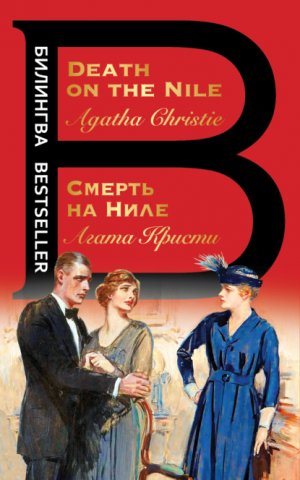
Смерть на Ниле / Death on the Nile Кристи Агата
Other possibilities:
Robbery as a motive. Possible, since the pearls have disappeared, and Linnet Doyle was certainly wearing them last night.
Someone with a grudge against the Ridgeway family. Possible – again no evidence.
We know that there is a dangerous man on board – a killer. Here we have a killer and a death. May not the two be connected? But we should have to show that Linnet Doyle possessed dangerous knowledge concerning this man.
Conclusions: We can group the persons on board into two classes – those who had a possible motive or against whom there is definite evidence, and those who, as far as we know, are free of suspicion.
Group IGroup II
Andrew Pennington Mrs Allerton
Fleetwood Tim Allerton
Rosalie Otterbourne Cornelia Robson
Miss Van Schuyler Miss Bowers
Louise Bourget (Robbery?) Dr Bessner
Ferguson (Political?) Signor Richetti
Mrs Otterbourne
James Fanthorp
Poirot pushed the paper back.
‘It is very just, very exact, what you have written there.’
‘You agree with it?’
‘Yes.’
‘And now what is your contribution?’
Poirot drew himself up in an important manner.
‘Me, I pose myself one question: “Why was the pistol thrown overboard?”’
‘That’s all?’
‘At the moment, yes. Until I can arrive at a satisfactory answer to that question, there is not sense anywhere. That is – that must be – the starting point. You will notice, my friend, that in your summary of where we stand, you have not attempted to answer that point.’
Race shrugged his shoulders.
‘Panic.’
Poirot shook his head perplexedly. He picked up the sodden velvet wrap and smoothed it out, wet and limp, on the table. His fingers traced the scorched marks and the burnt holes.
‘Tell me, my friend,’ he said suddenly. ‘You are more conversant with firearms than I am. Would such a thing as this, wrapped round a pistol, make much difference in muffling the sound?’
‘No, it wouldn’t. Not like a silencer, for instance.’
Poirot nodded. He went on:
‘A man – certainly a man who had had much handling of firearms – would know that. But a woman – a woman would not know.’
Race looked at him curiously.
‘Probably not.’
‘No. She would have read the detective stories where they are not always very exact as to details.’
Race flicked the little pearl-handled pistol with his finger.
‘This little fellow wouldn’t make much noise anyway,’ he said. ‘Just a pop, that’s all. With any other noise around, ten to one you wouldn’t notice it.’
‘Yes, I have reflected as to that.’
Poirot picked up the handkerchief and examined it.
‘A man’s handkerchief – but not a gentleman’s handkerchief. Ce cher Woolworth, I imagine. Three pence at most.’
‘The sort of handkerchief a man like Fleetwood would own.’
‘Yes. Andrew Pennington, I notice, carries a very fine silk handkerchief.’
‘Ferguson?’ suggested Race.
‘Possibly. As a gesture. But then it ought to be a bandana.’
‘Used it instead of a glove, I suppose, to hold the pistol and obviate fingerprints.’ Race added, with slight facetiousness, ‘ “The Clue of the Blushing Handkerchief.” ’
‘Ah, yes. Quite a jeune fille colour, is it not?’
He laid it down and returned to the stole, once more examining the powder marks.
‘All the same,’ he murmured, ‘it is odd…’
‘What’s that?’
Poirot said gently:
‘Cette pauvre Madame Doyle. Lying there so peacefully… with the little hole in her head. You remember how she looked?’
Race looked at him curiously.
‘You know,’ he said, ‘I’ve got an idea you’re trying to tell me something – but I haven’t the faintest idea what it is.’
Chapter 18
There was a tap on the door.
‘Come in,’ Race called.
A steward entered.
‘Excuse me, sir,’ he said to Poirot, ‘but Mr Doyle is asking for you.’
‘I will come.’
Poirot rose. He went out of the room and up the companionway to the promenade deck and along it to Dr Bessner’s cabin.
Simon, his face flushed and feverish, was propped up with pillows. He looked embarrassed.
‘Awfully good of you to come along, Monsieur Poirot. Look here, there’s something I want to ask you.’
‘Yes?’
Simon got still redder in the face.
‘It’s – it’s about Jackie. I want to see her. Do you think – would you mind – would she mind, d’you think – if you asked her to come along here? You know I’ve been lying here thinking… That wretched kid – she is only a kid after all – and I treated her damn’ badly – and-’ He stammered to silence.
Poirot looked at him with interest.
‘You desire to see Mademoiselle Jacqueline? I will fetch her.’
‘Thanks. Awfully good of you.’
Poirot went on his quest. He found Jacqueline de Bellefort sitting huddled up in a corner of the observation saloon. There was an open book on her lap but she was not reading.
Poirot said gently:
‘Will you come with me, Mademoiselle? Monsieur Doyle wants to see you.’
She started up. Her face flushed – then paled. She looked bewildered.
‘Simon? He wants to see me – to see me?’
He found her incredulity moving.
‘Will you come, Mademoiselle?’
She went with him in a docile fashion, like a child, but like a puzzled child.
‘I – yes, of course I will.’
Poirot passed into the cabin.
‘Here is Mademoiselle.’
She stepped in after him, wavered, stood still… standing there mute and dumb, her eyes fixed on Simon’s face.
‘Hallo, Jackie.’ He, too, was embarrassed. He went on: ‘Awfully good of you to come. I wanted to say – I mean – what I mean is-’
She interrupted him then. Her words came out in a rush – breathless, desperate…
‘Simon – I didn’t kill Linnet. You know I didn’t do that… I–I-was mad last night. Oh, can you ever forgive me?’
Words came more easily to him now.
‘Of course. That’s all right! Absolutely all right! That’s what I wanted to say. Thought you might be worrying a bit, you know…’
‘Worrying? A bit? Oh! Simon!’
‘That’s what I wanted to see you about. It’s quite all right, see, old girl? You just got a bit rattled last night – a shade tight. All perfectly natural.’
‘Oh, Simon! I might have killed you…’
‘Not you. Not with a rotten little peashooter like that…’
‘And your leg! Perhaps you’ll never walk again…’
‘Now, look here, Jackie, don’t be maudlin. As soon as we get to Aswan they’re going to put the X-rays to work, and dig out that tinpot bullet, and everything will be as right as rain.’
Jacqueline gulped twice, then she rushed forward and knelt down by Simon’s bed, burying her face and sobbing. Simon patted her awkwardly on the head. His eyes met Poirot’s and, with a reluctant sigh, the latter left the cabin.
He heard broken murmurs as he went:
‘How could I be such a devil? Oh, Simon!.. I’m so dreadfully sorry…’
Outside Cornelia Robson was leaning over the rail. She turned her head.
‘Oh, it’s you, Monsieur Poirot. It seems so awful somehow that it should be such a lovely day.’
Poirot looked up at the sky.
‘When the sun shines you cannot see the moon,’ he said. ‘But when the sun is gone – ah, when the sun is gone.’
Cornelia’s mouth fell open.
‘I beg your pardon?’
‘I was saying, Mademoiselle, that when the sun has gone down, we shall see the moon. That is so, is it not?’
‘Why – why, yes – certainly.’
Poirot laughed gently.
‘I utter the imbecilities,’ he said. ‘Take no notice.’
He strolled gently towards the stern of the boat. As he passed the next cabin he paused for a minute. He caught fragments of speech from within.
‘Utterly ungrateful – after all I’ve done for you – no consideration for your wretched mother… no idea of what I suffer…’
Poirot’s lips stiffened as he pressed them together. He raised a hand and knocked.
There was a startled silence and Mrs Otterbourne’s voice called out:
‘Who’s that?’
‘Is Mademoiselle Rosalie there?’
Rosalie appeared in the doorway. Poirot was shocked at her appearance. There were dark circles under her eyes and drawn lines round her mouth.
‘What’s the matter?’ she said ungraciously. ‘What do you want?’
‘The pleasure of a few minutes’ conversation with you, Mademoiselle. Will you come?’
Her mouth went sulky at once. She shot him a suspicious look.
‘Why should I?’
‘I entreat you, Mademoiselle.’
‘Oh, I suppose-’
She stepped out on the deck, closing the door behind her.
‘Well?’
Poirot took her gently by the arm and drew her along the deck, still in the direction of the stern. They passed the bathrooms and round the corner. They had the stern part of the deck to themselves. The Nile flowed away behind them.
Poirot rested his elbows on the rail. Rosalie stood up straight and stiff.
‘Well?’ she asked again, and her voice held the same ungracious tone.
Poirot spoke slowly, choosing his words.
‘I could ask you certain questions, Mademoiselle, but I do not think for one moment that you would consent to answer them.’
‘Seems rather a waste to bring me along here then.’
Poirot drew a finger slowly along the wooden rail.
‘You are accustomed, Mademoiselle, to carrying your own burdens… But you can do that too long. The strain becomes too great. For you, Mademoiselle, the strain is becoming too great.’
‘I don’t know what you are talking about,’ said Rosalie.
‘I am talking about facts, Mademoiselle – plain ugly facts. Let us call the spade the spade and say it in one little short sentence. Your mother drinks, Mademoiselle.’
Rosalie did not answer. Her mouth opened, then she closed it again. For once she seemed at a loss.
‘There is no need for you to talk, Mademoiselle. I will do all the talking. I was interested at Aswan in the relations existing between you. I saw at once that, in spite of your carefully studied unfilial remarks, you were in reality passionately protecting her from something. I very soon knew what that something was. I knew it long before I encountered your mother one morning in an unmistakable state of intoxication. Moreover, her case, I could see, was one of secret bouts of drinking – by far the most difficult kind of case with which to deal. You were coping with it manfully. Nevertheless, she had all the secret drunkard’s cunning. She managed to get hold of a secret supply of spirits and to keep it successfully hidden from you. I should not be surprised if you discovered its hiding place only yesterday. Accordingly, last night, as soon as your mother was really soundly asleep, you stole out with the contents of the cache, went round to the other side of the boat (since your own side was up against the bank) and cast it overboard into the Nile.’
He paused.
‘I am right, am I not?’
‘Yes – you’re quite right.’ Rosalie spoke with sudden passion. ‘I was a fool not to say so, I suppose! But I didn’t want everyone to know. It would go all over the boat. And it seemed so – so silly – I mean – that I-’
Poirot finished the sentence for her. ‘So silly that you should be suspected of committing a murder?’
Rosalie nodded. Then she burst out again.
‘I’ve tried so hard to – keep everyone from knowing… It isn’t really her fault. She got discouraged. Her books didn’t sell any more. People are tired of all that cheap sex stuff… It hurt her – it hurt her dreadfully. And so she began to – to drink. For a long time I didn’t know why she was so queer. Then, when I found out, I tried to – to stop it. She’d be all right for a bit, and then, suddenly, she’d start, and there would be dreadful quarrels and rows with people. It was awful.’ She shuddered. ‘I had always to be on the watch – to get her away…’ ‘And then – she began to dislike me for it. She – she’s turned right against me. I think she almost hates me sometimes.’
‘Pauvre petite,’ said Poirot.
She turned on him vehemently.
‘Don’t be sorry for me. Don’t be kind. It’s easier if you’re not.’ She sighed – a long heart-rending sigh. ‘I’m so tired… I’m so deadly, deadly tired.’
‘I know,’ said Poirot.
‘People think I’m awful. Stuck-up and cross and bad-tempered. I can’t help it. I’ve forgotten how to be – to be nice.’
‘That is what I said to you – you have carried your burden by yourself too long.’
Rosalie said slowly:
‘It’s a relief – to talk about it. You – you’ve always been kind to me, Monsieur Poirot. I’m afraid I’ve been rude to you often.’
‘La politesse, it is not necessary between friends.’
The suspicion came back to her face suddenly.
‘Are you – are you going to tell everyone? I suppose you must, because of those damned bottles I threw overboard.’
‘No, no, it is not necessary. Just tell me what I want to know. At what time was this? Ten minutes past one?’
‘About that, I should think. I don’t remember exactly.’
‘Now tell me, Mademoiselle. Mademoiselle Van Schuyler saw you, did you see her?’
Rosalie shook her head.
‘No, I didn’t.’
‘She says that she looked out of the door of her cabin.’
‘I don’t think I should have seen her. I just looked along the deck and then out to the river.’
Poirot nodded.
‘And did you see anyone at all when you looked down the deck?’
There was a pause – quite a long pause. Rosalie was frowning. She seemed to be thinking earnestly.
At last she shook her head quite decisively.
‘No,’ she said. ‘I saw nobody.’
Hercule Poirot slowly nodded his head. But his eyes were grave.
Chapter 19
People crept into the dining saloon by ones and twos in a very subdued manner. There seemed a general feeling that to sit down eagerly to food displayed an unfortunate heartlessness. It was with an almost apologetic air that one passenger after another came and sat down at their tables.
Tim Allerton arrived some few minutes after his mother had taken her seat. He was looking in a thoroughly bad temper.
‘I wish we’d never come on this blasted trip,’ he growled.
Mrs Allerton shook her head sadly.
‘Oh, my dear, so do I. That beautiful girl! It all seems such a waste. To think that anyone could shoot her in cold blood. It seems awful to me that anyone could do such a thing. And that other poor child.’
‘Jacqueline?’
‘Yes; my heart aches for her. She looks so dreadfully unhappy.’
‘Teach her not to go round loosing off toy firearms,’ said Tim unfeelingly as he helped himself to butter.
‘I expect she was badly brought up.’
‘Oh, for God’s sake, Mother, don’t go all maternal about it.’
‘You’re in a shocking bad temper, Tim.’
‘Yes I am. Who wouldn’t be?’
‘I don’t see what there is to be cross about. It’s just frightfully sad.’
Tim said crossly:
‘You’re taking the romantic point of view! What you don’t seem to realize is that it’s no joke being mixed up in a murder case.’
Mrs Allerton looked a little startled.
‘But surely-’
‘That’s just it. There’s no “But surely” about it. Everyone on this damned boat is under suspicion – you and I as well as the rest of them.’
Mrs Allerton demurred.
‘Technically we are, I suppose – but actually it’s ridiculous!’
‘There’s nothing ridiculous where murder’s concerned! You may sit there, darling, just exuding virtue and conscious rectitude, but a lot of unpleasant policeman at Shellal or Aswan won’t take you at your face value.’
‘Perhaps the truth will be known before then.’
‘Why should it be?’
‘Monsieur Poirot may find out.’
‘That old mountebank? He won’t find out anything. He’s all talk and moustaches.’
‘Well, Tim,’ said Mrs Allerton. ‘I daresay everything you say is true, but even if it is, we’ve got to go through with it, so we might as well make up our minds to it and go through with it as cheerfully as we can.’
But her son showed no abatement of gloom.
‘There’s this blasted business of the pearls being missing, too.’
‘Linnet’s pearls?’
‘Yes. It seems somebody must have pinched ’em.’
‘I suppose that was the motive for the crime,’ said Mrs Allerton.
‘Why should it be? You’re mixing up two perfectly different things.’
‘Who told you that they were missing?’
‘Ferguson. He got it from his tough friend in the engine room, who got it from the maid.’
‘They were lovely pearls,’ said Mrs Allerton.
Poirot sat down at the table, bowing to Mrs Allerton.
‘I am a little late,’ he said.
‘I expect you have been busy,’ said Mrs Allerton.
‘Yes, I have been much occupied.’
He ordered a fresh bottle of wine from the waiter.
Читать бесплатно другие книги: