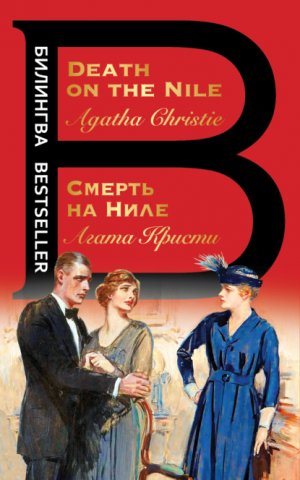
Смерть на Ниле / Death on the Nile Кристи Агата
‘We’re very catholic in our tastes,’ said Mrs Allerton. ‘You drink wine always, Tim drinks whisky and soda, and I try all the different brands of mineral water in turn.’
‘Tiens!’ said Poirot. He stared at her for a moment. He murmured to himself: ‘It is an idea, that…’
Then, with an impatient shrug of his shoulders, he dismissed the sudden preoccupation that had distracted him and began to chat lightly of other matters.
‘Is Mr Doyle badly hurt?’ asked Mrs Allerton.
‘Yes, it is a fairly serious injury. Dr Bessner is anxious to reach Aswan so that his leg can be X-rayed and the bullet removed. But he hopes that there will be no permanent impairment.’
‘Poor Simon,’ said Mrs Allerton. ‘Only yesterday he looked such a happy boy, with everything in the world he wanted. And now his beautiful wife killed and he himself laid up and helpless. I do hope, though-’
‘What do you hope, Madame?’ asked Poirot as Mrs Allerton paused.
‘I hope he’s not too angry with that poor child.’
‘With Mademoiselle Jacqueline? Quite the contrary. He was full of anxiety on her behalf.’ He turned to Tim. ‘You know, it is a pretty little problem of psychology, that. All the time that Mademoiselle Jacqueline was following them from place to place he was absolutely furious – but now, when she has actually shot him, and wounded him dangerously – perhaps made him physically impaired for life – all his anger seems to have evaporated. Can you understand that?’
‘Yes,’ said Tim thoughtfully, ‘I think I can. The first thing made him feel a fool-’
Poirot nodded.
‘You are right. It offended his male dignity.’
‘But now – if you look at it a certain way, it’s she who’s made a fool of herself. Everyone’s down on her, and so-’
‘He can be generously forgiving,’ finished Mrs Allerton. ‘What children men are!’
‘A profoundly untrue statement that women always make,’ murmured Tim.
Poirot smiled. Then he said to Tim:
‘Tell me, Madame Doyle’s cousin, Miss Joanna Southwood, did she resemble Madame Doyle?’
‘You’ve got it a little wrong, Monsieur Poirot. She was our cousin and Linnet’s friend.’
‘Ah, pardon – I was confused. She is a young lady much in the news, that. I have been interested in her for some time.’
‘Why?’ asked Tim sharply.
Poirot half rose to bow to Jacqueline de Bellefort, who had just come in and passed their table on the way to her own. Her cheeks were flushed and her eyes bright, and her breath came a little unevenly. As he resumed his seat Poirot seemed to have forgotten Tim’s question. He murmured vaguely:
‘I wonder if all young ladies with valuable jewels are as careless as Madame Doyle was?’
‘It is true, then, that they were stolen?’ asked Mrs Allerton.
‘Who told you so, Madame?’
‘Ferguson said so,’ said Tim.
Poirot nodded gravely.
‘It is quite true.’
‘I suppose,’ said Mrs Allerton nervously, ‘that this will mean a lot of unpleasantness for all of us. Tim says it will.’
Her son scowled. But Poirot had turned to him.
‘Ah! You have had previous experience, perhaps? You have been in a house where there was a robbery?’
‘Never,’ said Tim.
‘Oh, yes, darling, you were at the Portarlingtons’ that time – when that awful woman’s diamonds were stolen.’
‘You always get things hopelessly wrong, Mother. I was there when it was discovered that the diamonds she was wearing round her fat neck were only paste! The actual substitution was probably done months earlier. As a matter of fact, a lot a people said she’d had it done herself!’
‘Joanna said so, I expect.’
‘Joanna wasn’t there.’
‘But she knew them quite well. And it’s very like her to make that kind of suggestion.’
‘You’re always down on Joanna, Mother.’
Poirot hastily changed the subject. He had it in mind to make a really big purchase at one of the Aswan shops. Some very attractive purple and gold material at one of the Indian merchants. There would, of course, be the duty to pay, but-
‘They tell me that they can – how do you say – expedite it for me. And that the charges will not be too high. How think you, will it arrive all right?’
Mrs Allerton said that many people, so she had heard, had had things sent straight to England from the shops in question and that everything had arrived safely.
‘Bien. Then I will do that. But the trouble one has, when one is abroad, if a parcel comes out from England! Have you had experience of that? Have you had any parcels arrive since you have been on your travels?’
‘I don’t think we have, have we, Tim? You get books sometimes, but of course there is never any trouble about them.’
‘Ah, no, books are different.’
Dessert had been served. Now, without any previous warning, Colonel Race stood up and made his speech.
He touched on the circumstances of the crime and announced the theft of the pearls. A search of the boat was about to be instituted, and he would be obliged if all the passengers would remain in the saloon until this was completed. Then, after that, if the passengers agreed, as he was sure they would, they themselves would be kind enough to submit to a search.
Poirot slipped nimbly along to his side. There was a little buzz and hum all round them. Voices doubtful, indignant, excited…
Poirot reached Race’s side and murmured something in his ear just as the latter was about to leave the dining saloon.
Race listened, nodded assent, and beckoned a steward. He said a few brief words to him; then, together with Poirot, he passed out on to the deck, closing the door behind him.
They stood for a minute or two by the rail. Race lit a cigarette.
‘Not a bad idea of yours,’ he said. ‘We’ll soon see if there’s anything in it. I’ll give ’em three minutes.’
The door of the dining saloon opened and the same steward to whom they had spoken came out. He saluted Race and said:
‘Quite right, sir. There’s a lady who says it’s urgent she should speak to you at once without delay.’
‘Ah!’ Race’s face showed satisfaction. ‘Who is it?’
‘Miss Bowers, sir, the hospital nurse lady.’
A slight shade of surprise showed on Race’s face. He said:
‘Bring her to the smoking-room. Don’t let anyone else leave.’
‘No, sir – the other steward will attend to that.’
He went back into the dining room. Poirot and Race went to the smoking room.
‘Bowers, eh?’ muttered Race.
They had hardly got inside the smoking room before the steward reappeared with Miss Bowers. He ushered her in and left, shutting the door behind him.
‘Well, Miss Bowers?’ Colonel Race looked at her inquiringly. ‘What’s all this?’
Miss Bowers looked her usual composed, unhurried self. She displayed no particular emotion.
‘You’ll excuse me, Colonel Race,’ she said, ‘but under the circumstances I thought the best thing to do would be to speak to you at once’-she opened her neat black handbag-‘and to return you these.’
She took out a string of pearls and laid them on the table.
Chapter 20
If Miss Bowers had been the kind of woman who enjoyed creating a sensation, she would have been richly repaid by the result of her action.
A look of utter astonishment passed over Colonel Race’s face as he picked up the pearls from the table.
‘This is most extraordinary,’ he said. ‘Will you kindly explain, Miss Bowers?’
‘Of course. That’s what I’ve come to do.’ Miss Bowers settled herself comfortably in a chair. ‘Naturally it was a little difficult for me to decide what it was best for me to do. The family would naturally be averse to scandal of any kind, and they trusted my discretion, but the circumstances are so very unusual that it really leaves me no choice. Of course, when you didn’t find anything in the cabins, your next move would be a search of the passengers, and, if the pearls were then found in my possession, it would be rather an awkward situation and the truth would come out just the same.’
‘And just what is the truth? Did you take these pearls from Mrs Doyle’s cabin?’
‘Oh, no, Colonel Race, of course not. Miss Van Schuyler did.’
‘Miss Van Schuyler?’
‘Yes. She can’t help it, you know, but she does – er – take things. Especially jewellery. That’s really why I’m always with her. It’s not her health at all – it’s this little idiosyncrasy. I keep on the alert, and fortunately there’s never been any trouble since I’ve been with her. It just means being watchful, you know. And she always hides the things she takes in the same place – rolled up in a pair of stockings – so that it makes it very simple. I look each morning. Of course I’m a light sleeper, and I always sleep next door to her, and with the communicating door open if it’s in a hotel, so that I usually hear. Then I go after her and persuade her to go back to bed. Of course it’s been rather more difficult on a boat. But she doesn’t usually do it at night. It’s more just picking up things that she sees left about. Of course, pearls have a great attraction for her always.’
Miss Bowers ceased speaking.
Race asked: ‘How did you discover they had been taken?’
‘They were in her stockings this morning. I knew whose they were, of course. I’ve often noticed them. I went along to put them back, hoping that Mrs Doyle wasn’t up yet and hadn’t discovered her loss. But there was a steward standing there, and he told me about the murder and that no one could go in. So then, you see, I was in a regular quandary. But I still hoped to slip them back in the cabin later, before their absence had been noticed. I can assure you I’ve passed a very unpleasant morning wondering what was the best thing to do. You see, the Van Schuyler family is so very particular and exclusive. It would never do if this got into the newspapers. But that won’t be necessary, will it?’
Miss Bowers really looked worried.
‘That depends on circumstances,’ said Colonel Race cautiously. ‘But we shall do our best for you, of course. What does Miss Van Schuyler say to this?’
‘Oh, she’ll deny it, of course. She always does. Says some wicked person has put it there. She never admits taking anything. That’s why if you catch her in time she goes back to bed like a lamb. Says she just went out to look at the moon. Something like that.’
‘Does Miss Robson know about this – er – failing?’
‘No, she doesn’t. Her mother knows, but she’s a very simple kind of girl and her mother thought it best she should know nothing about it. I was quite equal to dealing with Miss Van Schuyler,’ added the competent Miss Bowers.
‘We have to thank you, Mademoiselle, for coming to us so promptly,’ said Poirot.
Miss Bowers stood up.
‘I’m sure I hope I acted for the best.’
‘Be assured that you have.’
‘You see, what with there being a murder as well-’
Colonel Race interrupted her. His voice was grave.
‘Miss Bowers, I am going to ask you a question, and I want to impress upon you that it has got to be answered truthfully. Miss Van Schuyler is unhinged mentally to the extent of being a kleptomaniac. Has she also a tendency to homicidal mania?’
Miss Bowers’ answer came immediately.
‘Oh, dear me, no! Nothing of that kind. You can take my word for it absolutely. The old lady wouldn’t hurt a fly.’
The reply came with such positive assurance that there seemed nothing more to be said. Nevertheless Poirot did interpolate one mild inquiry.
‘Does Miss Van Schuyler suffer at all from deafness?’
‘As a matter of fact she does, Monsieur Poirot. Not so that you’d notice in any way, not if you were speaking to her, I mean. But quite often she doesn’t hear you when you come into a room. Things like that.’
‘Do you think she would have heard anyone moving about in Mrs Doyle’s cabin, which is next door to her own?’
‘Oh, I shouldn’t think so – not for a minute. You see, the bunk is the other side of the cabin, not even against the partition wall. No, I don’t think she would have heard anything.’
‘Thank you, Miss Bowers.’
Race said: ‘Perhaps you will now go back to the dining saloon and wait with the others?’
He opened the door for her and watched her go down the staircase and enter the saloon. Then he shut the door and came back to the table. Poirot had picked up the pearls.
‘Well,’ said Race grimly, ‘that reaction came pretty quickly. That’s a very cool-headed and astute young woman – perfectly capable of holding out on us still further if she thinks it suits her book. What about Miss Marie Van Schuyler now? I don’t think we can eliminate her from the possible suspects. You know, she might have committed murder to get hold of those jewels. We can’t take the nurse’s word for it. She’s all out to do the best for the family.’
Poirot nodded in agreement. He was very busy with the pearls, running them through his fingers, holding them up to his eyes.
He said: ‘We may take it, I think, that part of the old lady’s story to us is true. She did look out of her cabin and she did see Rosalie Otterbourne. But I don’t think she heard anything or anyone in Linnet Doyle’s cabin. I think she was just peering out from her cabin preparatory to slipping along and purloining the pearls.’
‘The Otterbourne girl was there, then?’
‘Yes. Throwing her mother’s secret cache of drink overboard.’
Colonel Race shook his head sympathetically.
‘So that’s it! Tough on a young ’un.’
‘Yes, her life has not been very gay, cette pauvre petite Rosalie.’
‘Well, I’m glad that’s been cleared up. She didn’t see or hear anything?’
‘I asked her that. She responded – after a lapse of quite twenty seconds – that she saw nobody.’
‘Oh?’ Race looked alert.
‘Yes, it is suggestive, that.’
Race said slowly:
‘If Linnet Doyle was shot round about ten minutes past one, or indeed any time after the boat had quieted down, it has seemed amazing to me that no one heard the shot. I grant you that a little pistol like that wouldn’t make much noise, but all the same the boat would be deadly quiet, and any noise, even a little pop, should have been heard. But I begin to understand better now. The cabin on the forward side of hers was unoccupied – since her husband was in Dr Bessner’s cabin. The one aft was occupied by the Van Schuyler woman, who was deaf. That leaves only-’
He paused and looked expectantly at Poirot, who nodded.
‘The cabin next to her on the other side of the boat. In other words – Pennington. We always seem to come back to Pennington.’
‘We will come back to him presently with the kid gloves removed! Ah, yes, I am promising myself that pleasure.’
‘In the meantime we’d better get on with our search of the boat. The pearls still make a convenient excuse, even though they have been returned – but Miss Bowers is not likely to advertise the fact.’
‘Ah, these pearls!’ Poirot held them up against the light once more. He stuck out his tongue and licked them – he even gingerly tried one of them between his teeth. Then, with a sigh, he threw them down on the table. ‘Here are more complications, my friend,’ he said. ‘I am not an expert on precious stones, but I have had a good deal to do with them in my time and I am fairly certain of what I say. These pearls are only a clever imitation.’
Chapter 21
Colonel Race swore hastily.
‘This damned case gets more and more involved.’ He picked up the pearls. ‘I suppose you’ve not made a mistake? They look all right to me.’
‘They are a very good imitation – yes.’
‘Now where does that lead us? I suppose Linnet Doyle didn’t deliberately have an imitation made and bring it abroad with her for safety. Many women do.’
‘I think, if that were so, her husband would know about it.’
‘She may not have told him.’
Poirot shook his head in a dissatisfied manner.
‘No, I do not think that is so. I was admiring Madame Doyle’s pearls the first evening on the boat – their wonderful sheen and lustre. I am sure that she was wearing the genuine ones then.’
‘That brings us up against two possibilities. First, that Miss Van Schuyler only stole the imitation string after the real ones had been stolen by someone else. Second, that the whole kleptomaniac story is a fabrication. Either Miss Bowers is a thief, and quickly invented the story and allayed suspicion by handing over the false pearls, or else that whole party is in it together. That is to say, they are a gang of clever jewel thieves masquerading as an exclusive American family.’
‘Yes,’ Poirot murmured. ‘It is difficult to say. But I will point out to you one thing – to make a perfect and exact copy of the pearls, clasp and all, good enough to stand a chance of deceiving Madame Doyle, is a highly skilled technical performance. It could not be done in a hurry. Whoever copied those pearls must have had a good opportunity of studying the original.’
Race rose to his feet.
‘Useless to speculate about it any further now. Let’s get on with the job. We’ve got to find the real pearls. And at the same time we’ll keep our eyes open.’
They disposed of the cabins occupied on the lower deck.
That of Signor Richetti contained various archaeological works in different languages, a varied assortment of clothing, hair lotions of a highly scented kind and two personal letters – one from an archaeological expedition in Syria, and one from, apparently, a sister in Rome. His handkerchiefs were all of coloured silk.
They passed on to Ferguson’s cabin. There was a sprinkling of communistic literature, a good many snapshots, Samuel Butler’s Erewhon and a cheap edition of Pepys’ Diary. His personal possessions were not many. Most of what outer clothing there was was torn and dirty; the underclothing, on the other hand, was of really good quality. The handkerchiefs were expensive linen ones.
‘Some interesting discrepancies,’ murmured Poirot.
Race nodded.
‘Rather odd that there are absolutely no personal papers, letters, etc.’
‘Yes; that gives one to think. An odd young man, Monsieur Ferguson.’
He looked thoughtfully at a signet ring he held in his hand, before replacing it in the drawer where he had found it.
They went along to the cabin occupied by Louise Bourget. The maid had her meals after the other passengers, but Race had sent word that she was to be taken to join the others. A cabin steward met them.
‘I’m sorry, sir,’ he apologized, ‘but I’ve not been able to find the young woman anywhere. I can’t think where she can have got to.’
Race glanced inside the cabin. It was empty. They went up to the promenade deck and started on the starboard side. The first cabin was that occupied by James Fanthorp. Here all was in meticulous order. Mr Fanthorp travelled light, but all that he had was of good quality.
‘No letters,’ said Poirot thoughtfully. ‘He is careful, our Mr Fanthorp, to destroy his correspondence.’
They passed on to Tim Allerton’s cabin, next door.
There were evidences here of an Anglo-Catholic turn of mind – an exquisite little triptych, and a big rosary of intricately carved wood. Besides personal clothing, there was a half-completed manuscript, a good deal annotated and scribbled over, and a good collection of books, most of them recently published. There were also a quantity of letters thrown carelessly into a drawer. Poirot, never in the least scrupulous about reading other people’s correspondence, glanced through them. He noted that amongst them there were no letters from Joanna Southwood. He picked up a tube of Seccotine, fingered it absently for a minute or two, then said:
‘Let us pass on.’
‘No Woolworth handkerchiefs,’ reported Race, rapidly replacing the contents of a drawer.
Mrs Allerton’s cabin was the next. It was exquisitely neat, and a faint old-fashioned smell of lavender hung about it. The two men’s search was soon over. Race remarked as they left it:
‘Nice woman, that.’
The next cabin was that which had been used as a dressing-room by Simon Doyle. His immediate necessities – pyjamas, toilet things, etc. – had been moved to Bessner’s cabin, but the remainder of his possessions were still there – two good-sized leather suitcases and a kitbag. There were also some clothes in the wardrobe.
‘We will look carefully here, my friend,’ said Poirot, ‘for it is possible that the thief hid the pearls here.’
‘You think it is likely?’
‘But yes, indeed. Consider! The thief, whoever he or she may be, must know that sooner or later a search will be made, and therefore a hiding place in his or her own cabin would be injudicious in the extreme. The public rooms present other difficulties. But here is a cabin belonging to a man who cannot possibly visit it himself. So that if the pearls are found here it tells us nothing at all.’
But the most meticulous search failed to reveal any trace of the missing necklace. Poirot murmured ‘Zut!’ to himself and they emerged once more on the deck.
Linnet Doyle’s cabin had been locked after the body was removed, but Race had the key with him. He unlocked the door and the two men stepped inside.
Except for the removal of the girl’s body, the cabin was exactly as it had been that morning.
‘Poirot,’ said Race, ‘if there’s anything to be found here, for God’s sake go ahead and find it. You can if anyone can – I know that.’
‘This time you do not mean the pearls, mon ami?’
‘No. The murder’s the main thing. There may be something I overlooked this morning.’
Quietly, deftly, Poirot went about his search. He went down on his knees and scrutinized the floor inch by inch. He examined the bed. He went rapidly through the wardrobe and chest of drawers. He went through the wardrobe trunk and the two costly suitcases. He looked through the expensive gold-fitted dressing-case. Finally he turned his attention to the washstand. There were various creams, powders, face lotions. But the only thing that seemed to interest Poirot were two little bottles labelled Nailex. He picked them up at last and brought them to the dressing table. One, which bore the inscription Nailex Rose, was empty but for a drop or two of dark red fluid at the bottom. The other, the same size, but labelled Nailex Cardinal, was nearly full. Poirot uncorked first the empty, then the full one, and sniffed them both delicately.
An odour of pear drops billowed into the room. With a slight grimace he recorked them.
‘Get anything?’ asked Race.
Poirot replied by a French proverb: ‘On no prend pas les mouches avec le vinaigre.’ Then he said with a sigh: ‘My friend, we have not been fortunate. The murderer has not been obliging. He has not dropped for us the cuff link, the cigarette end, the cigar ash – or, in the case of the woman, the handkerchief, the lipstick, or the hair slide.’
‘Only the bottle of nail polish?’
Poirot shrugged his shoulders.
‘I must ask the maid. There is something – yes – a little curious there.’
‘I wonder where the devil the girl’s got to?’ said Race.
They left the cabin, locking the door behind them, and passed on to that of Miss Van Schuyler. Here again were all the appurtenances of wealth, expensive toilet fittings, good luggage, a certain number of private letters and papers all perfectly in order.
The next cabin was the double one occupied by Poirot, and beyond it that of Race.
‘Hardly like to hide ’em in either of these,’ said the Colonel.
Poirot demurred.
‘It might be. Once, on the Orient Express, I investigated a murder. There was a little matter of a scarlet kimono. It had disappeared, and yet it must be on the train. I found it – where do you think? In my own locked suitcase! Ah! It was an impertinence, that!’
‘Well, let’s see if anybody has been impertinent with you or me this time.’
But the thief of the pearls had not been impertinent with Hercule Poirot or with Colonel Race.
Rounding the stern they made a very careful search of Miss Bowers’ cabin but could find nothing of a suspicious nature. Her handkerchiefs were of plain linen with an initial.
The Otterbournes’ cabin came next. Here, again, Poirot made a very meticulous search – but with no result.
The next cabin was Bessner’s. Simon Doyle lay with an untasted tray of food beside him.
‘Off my feed,’ he said apologetically. He was looking feverish and very much worse than earlier in the day.
Poirot appreciated Bessner’s anxiety to get him as swiftly as possible to hospital and skilled appliances.
The little Belgian explained what the two of them were doing, and Simon nodded approval. On learning that the pearls had been restored by Miss Bowers but proved to be merely imitation, he expressed the most complete astonishment.
‘You are quite sure, Monsieur Doyle, that your wife did not have an imitation string which she brought abroad with her instead of the real ones?’
Simon shook his head decisively.
‘Oh, no. I’m quite sure of that. Linnet loved those pearls and she wore ’em everywhere. They were insured against every possible risk, so I think that made her a bit careless.’
‘Then we must continue our search.’
He started opening drawers. Race attacked a suitcase.
Simon stared.
‘Look here, you surely don’t suspect old Bessner pinched them?’
Poirot shrugged his shoulders.
‘It might be so. After all, what do we know of Dr Bessner? Only what he himself gives out.’
‘But he couldn’t have hidden them in here without my seeing him.’
‘He could not have hidden anything today without your having seen him. But we do not know when the substitution took place. He may have effected the exchange some days ago.’
‘I never thought of that.’
But the search was unavailing.
The next cabin was Pennington’s. The two men spent some time in their search. In particular, Poirot and Race examined carefully a case full of legal and business documents, most of them requiring Linnet’s signature.
Poirot shook his head gloomily.
‘These seem all square and above board. You agree?’
‘Absolutely. Still, the man isn’t a born fool. If there had been a compromising document there – a power of attorney or something of that kind – he’d be pretty sure to have destroyed it first thing.’
‘That is so, yes.’
Poirot lifted a heavy Colt revolver out of the top drawer of the chest of drawers, looked at it and put it back.
‘So it seems there are still some people who travel with revolvers,’ he murmured.
‘Yes, a little suggestive, perhaps. Still, Linnet Doyle wasn’t shot with a thing that size.’ Race paused and then said, ‘You know, I’ve thought of a possible answer to your point about the pistol being thrown overboard. Supposing that the actual murderer did leave it in Linnet Doyle’s cabin, and that someone else – some second person – took it away and threw it into the river?’
Читать бесплатно другие книги: