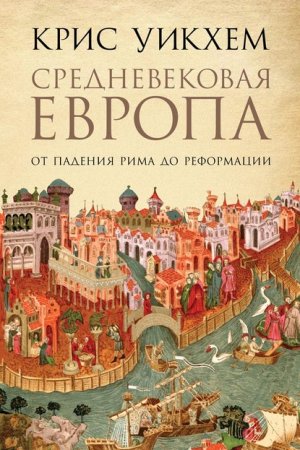
Средневековая Европа. От падения Рима до Реформации Уикхем Крис
Rubellin, M., glise et socit chrtienne d’Agobard Valds (Lyon, 2003).
Rubin, M., Corpus Christi (Cambridge, 1991).
– Gentile tales (Philadelphia, 1999).
– The hollow crown (London, 2005).
Rubin, M. and W. Simons (eds), The Cambridge history of Christianity, vol. 4 (Cambridge, 2009).
Ruggiero, G., The Renaissance in Italy (Cambridge, 2015).
Runciman, S., A history of the Crusades, 3 vols (Cambridge, 1951–54).
Rustow, M., Heresy and the politics of community (Ithaca, NY, 2008).
Ryan, M., ‘Bartolus of Sassoferrato and free cities’, Transactions of the Royal Historical Society, 6 ser., 10 (2000), 65–89.
Sabapathy, J., ‘Accountable rectores in comparative perspective’, in A. Brenger and F. Lachaud (eds), Hirarchie des pouvoirs, dlgation de pouvoir et responsabilit des administrateurs dans l’antiquit et au moyen ge (Metz, 2012), 201–30.
Sabapathy, J., Officers and accountability in medieval England 1170–1300 (Oxford, 2014).
Sablonier, R., ‘The Swiss confederation’, NCMH, vol. 7 (1998), 645–70.
Sackville, L., Heresy and heretics in the thirteenth century (York, 2011).
Sadeghi, B. and M. Goudarzi, ‘San‘’ 1 and the origins of the Qur’n’, Der Islam, 87 (2012), 1–129.
Sales i Fav, Ll., ‘Suing in a local jurisdictional court in late medieval Catalonia’, Continuity and change, 29 (2014), 49–81.
Salvatori, E., La popolazione pisana nel Duecento (Pisa, 1994).
Salvestrini, F., (ed.), L’Italia alla fine del medioevo, vol. 1 (Florence, 2006).
Sanders, G. D. R., ‘Corinth’, in Laiou, The economic history, vol. 2, 647–54.
Sanders, P., Ritual, politics and the city in Fatimid Cairo (Albany, NY, 1994).
Sansterre, J.-M., Les moines grecs et orientaux Rome aux poques byzantine et carolingienne (Brussels, 1983).
Sapori, A., La crisi delle compagnie mercantili dei Bardi e dei Peruzzi (Florence, 1926).
Sarris, P., Economy and society in the age of Justinian (Cambridge, 2006).
– Empires of faith, 500–700 (Oxford, 2011).
Sassier, Y., ‘L’utilisation d’un concept romain aux temps carolingiens’, Mdivales, 15 (1988), 17–29.
Sawyer, B. and P. Sawyer, Medieval Scandinavia (Minneapolis, 1993).
Sawyer, P., ‘Kings and royal power’, in Mortensen and Rasmussen, Fra stamme til stat, vol. 2, 282–8.
– (ed.), The Oxford illustrated history of the Vikings (Oxford, 1997).
Sayers, J., Innocent III (London, 1994).
Scales, L., The shaping of German identity (Cambridge, 2012).
Scase, W., ‘“Strange and wonderful bills” ’, in R. Copeland et al. (eds), New medieval literatures, vol. 2 (Oxford, 1998), 225–47.
Schieffer, R., Die Entstehung des ppstlichen Investiturverbots fr den deutschen Knig (Stuttgart, 1981).
Schmitt, O. J., ‘Les hommes et le pouvoir’, in idem, au moyen ge tardif (Paris, Collge de France, 2011), online edn at http://books.openedition.org/cdf/1511, accessed 12 July 2015. Korula sous la domination de Venise au XVe sicle: pouvoir, conomie et vie quotidienne dans une le dalmate
Schneidmller, B., Die Welfen (Stuttgart, 2000).
Scholz, S., Politik – Selbstverstndnis – Selbstdarstellung (Stuttgart, 2006).
Scott, T., The city-state in Europe, 1000–1600 (Oxford, 2012).
– ‘The economic policies of the regional city-states of Renaissance Italy’, Quaderni storici, 49 (2014), 219–63.
Scull, C., ‘Urban centres in pre-Viking England?’, in J. Hines (ed.), The Anglo-Saxons from the migration period to the eighth century (Woodbridge, 1997), 269–310.
Seibt, F., ‘Die Zeit der Luxemburger und der hussitischen Revolution’, in K. Bosl (ed.), Handbuch der Geschichte der bhmischen Lnder, vol. 1 (Stuttgart, 1967), 351–568.
Seidel, I., Byzanz im Spiegel der literarischen Entwicklung Frankreichs im 12. Jahrhundert (Frankfurt, 1977).
Semple, S., ‘Sacred spaces and places in pre-Christian and conversion period Anglo-Saxon England’, in H. Hamerow et al. (eds), The Oxford handbook of Anglo-Saxon archaeology (Oxford, 2011), 742–63.
Senatore, F., ‘The kingdom of Naples’, in Gamberini and Lazzarini, The Italian Renaissance state, 30–49.
evenko, I., ‘Re-reading Constantine Porphyrogenitus’, in J. Shepard and S. Franklin (eds), Byzantine diplomacy (Aldershot, 1992), 167–95.
Shepard, J., ‘Bulgaria’, NCMH, vol. 3 (1999), 567–85.
– (ed.), The Cambridge history of the Byzantine empire, c. 500–1492 (Cambridge, 2008).
Shepard, J. and S. Franklin, The emergence of Rus, 750–1200 (London, 1996).
Sidonius Apollinaris, Carmina and Epistolae, ed. and trans. W. B. Anderson, Poems and letters, 2 vols (Cambridge, MA, 1936–65). Русский перевод фрагментов в книге: Памятники средневековой латинской литературы IV–VII веков. – М.: Наследие, 1998.
Signes Codoer, J., The emperor Theophilos and the east, 829–842 (Farnham, 2014).
Simms, K., From kings to warlords (Woodbridge, 1987).
Simons, W., Cities of ladies (Philadelphia, 2001).
Sizgorich, T., ‘Narrative and community in Islamic late antiquity’, Past and present, 185 (2004), 9–42.
Skinner, P., Medieval Amalfi and its diaspora, 800–1250 (Oxford, 2013).
– Women in medieval Italian society, 500–1200 (Harlow, 2001).
Skinner, Q., The foundations of modern political thought, vol. 1 (Cambridge, 1978).
Skoda, H., Medieval violence (Oxford, 2013).
– ‘La Vierge et la vieille’, in T. Kouam (ed.), Experts et expertise au Moyen ge (Paris, 2012), 299–311.
Skovgaard-Petersen, I., ‘The making of the Danish kingdom’, in K. Helle (ed.), The Cambridge history of Scandinavia, vol. 1 (Cambridge, 2003), 163–83.
mahel, F., Die hussitische Revolution, 3 vols (Hannover, 2002).
Small, G., Late medieval France (Basingstoke, 2009).
Smith, J. M. H., ‘Einhard: the sinner and the saints’, Transactions of the Royal Historical Society, 13 (2003), 55–77.
– Europe after Rome (Oxford, 2005).
– ‘Rulers and relics c. 750–950’, Past and present, supplement 5 (2010), 73–96.
Snorri Sturluson, Heimskringla, ed. Bjarni Aalbjarnarson, 3 vols, slenzk fornrit, vols 26–28 (Reykjavk, 1941–51): Hkona saga goa (vol. 1, 150–97), lfs saga Tryggvasonar (vol. 1, 225–372), lfs saga ins Helga (vol. 2); trans. L. M. Hollander (Austin, TX, 1964). Русский перевод: Стурлусон С. Круг Земной. – М.: Наука, 1980.
Southern, R. W., Saint Anselm (Cambridge, 1990).
– Scholastic humanism and the making of Europe, 2 vols (Oxford, 1995–2001).
– The making of the middle ages (London, 1953).
– Western society and the church in the middle ages (London, 1970).
Spiegel, G. M., Romancing the past (Berkeley, 1993).
Spufford, P., Money and its use in medieval Europe (Cambridge, 1988).
– Power and profit (New York, 2002).
Squatriti, P., ‘Digging ditches in early medieval Europe’, Past and present, 176 (2002), 11–65.
Stafford, P., Queen Emma and Queen Edith (Oxford, 1997).
– Queens, concubines and dowagers (London, 1983).
– Unification and conquest (London, 1989).
Stancliffe, C., ‘Religion and society in Ireland’, NCMH, vol. 1 (2005), 397–425.
Statuta sive leges municipales Arelatis, ed. C. Giroud, Essai sur l’histoire du droit franais au Moyen ge, vol. 2 (Paris, 1846), 185–245.
Stephenson, P., Byzantium’s Balkan frontier (Cambridge, 2000).
Stevenson, K., Power and propaganda (Edinburgh, 2014).
Stock, B., The implications of literacy (Princeton, 1983).
Stokes, L., Demons of urban reform (Basingstoke, 2011).
Stone, R., Morality and masculinity in the Carolingian empire (Cambridge, 2011).
Stone, R. and C. West (eds), Hincmar of Rheims (Manchester, 2015).
Storia medievale (Rome, 1998).
Story, J., Carolingian connections (Aldershot, 2003).
– (ed.), Charlemagne (Manchester, 2005).
Strayer, J. R., The reign of Philip the Fair (Princeton, 1980).
Strohm, P., Social Chaucer (Cambridge, MA, 1989).
Stuard, S. M., A state of deference (Philadephia, 1992).
– ‘Brideprice, dowry, and other marital assigns’, in Bennett and Karras, The Oxford hand-book of women and gender, 148–62.
Sumption, J., The Hundred Years War, 4 vols (London, 1990–2015).
Sverris saga, ed. Thorleifur Hauksson, slenzk fornrit, vol. 30 (Reykjavk, 2007). Русский перевод: Сага о Сверрире. – М.: Наука, 1988.
Swanson, R. N., Religion and devotion in Europe, c.1215 – c.1515 (Cambridge, 1995).
– Universities, academics and the Great Schism (Cambridge, 1979).
Sykes, K., Inventing Sempringham (Berlin, 2011).
Tabacco, G., The struggle for power in medieval Italy (Cambridge, 1989).
Tabacco, G., and G. G. Merlo, Medioevo (Bologna, 1981).
Takayama, H., The administration of the Norman kingdom of Sicily (Leiden, 1993).
Tanner, N. P. (ed.), Decrees of the ecumenical councils, vol. 1 (London, 1990).
Tanner, R., The late medieval Scottish parliament (East Linton, 2001).
Taylor, A., The shape of the state in medieval Scotland (Oxford, 2016).
Taylor, Cl., Heresy, crusade and inquisition in medieval Quercy (Woodbridge, 2011).
Taylor, Cr., Joan of Arc: la Pucelle (Manchester, 2006).
– ‘War, propaganda and diplomacy in fifteenth-century France and England’, in C. Allmand (ed.), War, government and power in late medieval France (Liverpool, 2000), 70–91.
TeBrake, W. H., A plague of insurrection (Philadelphia, 1993).
Tellenbach, G., ‘Die geistigen und politischen Grundlagen der karolingischen Thronfolge’, Frhmittelalteriche Studien, 13 (1979), 184–302.
– Knigtum und Stamme in der Werdezeit des eutschen Reiches (Weimar, 1939).
– The church in western Europe from the tenth to the early twelfth century (Cambridge, 1993).
Teuscher, S., Lords’ rights and peasant stories (Philadelphia, 2012).
The Book of Margery Kempe, ed. B. Windeatt (Cambridge, 2004); trans. A. Bale (Oxford, 2015).
The Cambridge economic history of Europe, vols 1, 2 (2nd edn) and 3, ed. M. M. Postan et al. (Cambridge, 1963–87).
The new Cambridge medieval history, 7 vols (Cambridge, 1995–2005) [NCMH].
Thietmar of Merseburg, Chronicon, ed. R. Holtzmann, MGH, Scriptores rerum Germanicarum, N. S., vol. 9 (Berlin, 1935), trans. D. A. Warner, Ottonian Germany (Manchester, 2001). Русский перевод: Титмар Мерзебургский. Хроника. – М.: Русская панорама, 2009.
Thomas, L., ‘La vie prive de Guillaume de Nogaret’, Annales du Midi, 16 (1904), 161–207.
Thompson, A., Francis of Assisi (Ithaca, NY, 2012).
– Revival preachers and politics in thirteenth-century Italy (Oxford, 1992).
Tibi, A. T., The Tibyn: memoirs of ‘Abd Allh b. Buluggn, last Zrid amr of Granada (Leiden, 1986).
Titone, F., ‘The kingdom of Sicily’, in Gamberini and Lazzarini, The Italian Renaissance state, 9–29.
To parchikon biblion, the Book of the Eparch, le livre du prfet (London, 1970). Русский перевод: Византийская Книга Эпарха / Вступ. статья, пер., коммент. М. Я. Сюзюмова. – М.: Издательство восточной литературы, 1962.
Torre, A., Il consumo di devozioni (Venice, 1995).
Toubert, P., ‘Les statuts communaux et l’histoire des campagnes lombardes au XIVe sicle’, Mlanges d’archologie et d’histoire, 72 (1960), 397–508.
– Les structures du Latium mdival (Rome, 1973).
– L’Europe dans sa premire croissance (Paris, 2004).
Tout, T. F., Chapters in the administrative history of mediaeval England, vol. 2 (Manchester, 1920).
Trexler, R. C., Public life in Renaissance Florence (New York, 1980).
Tyerman, C., God’s war (London, 2006).
Urbaczyk, P. and S. Rosik, ‘Poland’, in Berend, Christianization, 263–318.
Valden Baruque, J., Los conflictos sociales en el reino de Castilla en los siglos XIV y XV (Madrid, 1975).
Vale, M., The princely court (Oxford, 2001).
Valente, C., ‘The deposition and abdication of Edward II’, English historical review, 113 (1998), 852–81.
Valenti, M., L’insediamento altomedievale nelle campagne toscane (Florence, 2004).
Vallejo Triano, A., Madinat al-Zahra (Seville, 2004).
Vallerani, M., Medieval public justice (Washington, DC, 2012).
van Bavel, B., Manors and markets (Oxford, 2010).
Van Dam, R., Leadership and community in late antique Gaul (Berkeley, 1985).
Van Engen, J. H., Sisters and brothers of the common life (Philadelphia, 2008).
Vauchez, A., Francis of Assisi (New Haven, 2012).
– ‘The Church and the laity’, NCMH, vol. 5 (1999), 182–203.
– The laity in the middle ages (Notre Dame, IN, 1993).
Verhulst, A., The Carolingian economy (Cambridge, 2002).
– The rise of cities in north-west Europe (Cambridge, 1999).
Vie de Thodore de Sykn, ed. A.-J. Festugire, 2 vols (Brussels, 1970). Русский перевод: Житие преподобного Отца нашего Феодора, архимандрита Сикеонского, написанное Георгием, учеником его и игуменом той же обители / Пер., предисл. и коммент. Д. Е. Афиногенова. – М.: Индрик, 2005.
Vignoli, P. (ed.), I costituti della legge e dell’uso di Pisa (sec. XII) (Rome, 2003).
Viguera Molins, M. J. (ed.), Los reinos de Taifas: Al-Andalus en el siglo XI (Madrid, 1994).
Villalon, L. J. A. and D. J. Kagay (eds), The Hundred Years War: a wider focus (Leiden, 2005).
Violante, C., ‘I laici nel movimento patarino’ in I laici nella «societas cristiana» dei secoli XI e XII (Milan, 1968), 587–687.
Vita sanctae Geretrudis, ed. B. Krusch, MGH, Scriptores rerum Merovingicarum, vol. 2 (Hannover, 1888), 447–74, trans. P. Fouracre and R. A. Gerberding, Late Merovingian France (Manchester, 1996), 301–26.
Vollrath, H., ‘Sutri 1046 – Canossa 1077 – Rome 1111’, in Noble and Van Engen, European transformations, 132–70.
von Euw, A. and P. Schreiner (eds), Kaiserin Theophanu (Cologne, 1991).
Waddell, H., The wandering scholars of the middle ages (London, 1932).
Wagner, D. M. et al., ‘Yersinia pestis and the plague of Justinian 541–543 AD: a genomic analysis’, The Lancet infectious diseases, 14.4 (2014), 319–26.
Waley, D. and T. Dean, The Italian city-republics, 4th edn (Harlow, 2010).
Wallace, D., Chaucerian polity (Stanford, 1997).
Walmsley, A., Early Islamic Syria (London, 2007).
Walsham, A., The Reformation of the landscape (Oxford, 2011).
Wamers, E., Die frhmittelalterlichen Lesefunde aus der Lhrstrasse (Baustelle Hilton II) in Mainz (Mainz, 1994).
Ward-Perkins, B., The fall of Rome and the end of civilization (Oxford, 2005).
Wasserstein, D., The rise and fall of the party-kings (Princeton, 1985).
Watanabe, M., The political ideas of Nicholas of Cusa (Geneva, 1963).
Watson, A., The evolution of law (Oxford, 1985).
Watts, J., Henry VI and the politics of kingship (Cambridge, 1996).
– ‘Ideas, principles and politics’, in A. J. Pollard (ed.), The Wars of the Roses (Basingstoke, 1995), 110–33, 234–7.
– The making of polities (Cambridge, 2009).
– ‘The pressure of the public on later medieval politics’, in L. Clark and C. Carpenter (eds), Political culture in late medieval Britain (Woodbridge, 2004), 159–80.
Wemple, S. and J. A. McNamara, ‘The power of women through the family in medieval Europe, 500–1100’, Feminist studies, 1 (1973), 126–41.
Wei, I. P., Intellectual culture in medieval Paris (Cambridge, 2012).
Werner, K. F., ‘Important noble families in the kingdom of Charlemagne’, in T. Reuter (ed.), The medieval nobility (Amsterdam, 1975), 137–202.
– Les origines avant l’an Mil (Paris, 1984).
– ‘Missus-marchio-comes’, in W. Paravicini and K. F. Werner (eds), Histoire compare de l’administration (IVe – XVIIIe sicles) (Munich, 1980), 191–239.
Werner, M., Der Ltticher Raum in frhkarolingischer Zeit (Gttingen, 1980).
West, C., ‘Competing for the Holy Spirit’, in P. Depreux et al. (eds), Comptition et sacr au haut moyen ge (Turnhout, 2015), 347–60.
– ‘Lordship in ninth-century Francia’, Past and present, 226 (2015), 3–40.
– Reframing the feudal revolution (Cambridge, 2013).
Whaley, J., Germany and the Holy Roman Empire, vol. 1 (Oxford, 2012).
Whelan, R., Being Christian in Vandal Africa (in press).
White, S. D., Feuding and peace-making in eleventh-century France (Aldershot, 2005).
– Re-thinking kinship and feudalism in early medieval Europe (Aldershot, 2005).
Whittaker, C. R., Frontiers of the Roman empire (Baltimore, 1994).
Whittle, J., The development of agrarian capitalism (Oxford, 2000).
Whittow, M., ‘The Byzantine economy (600–1204) ’, in Shepard, The Cambridge history of the Byzantine empire, 465–92.
– The making of Orthodox Byzantium, 600–1025 (Basingstoke, 1996).
Wickham, C., Community and clientele in twelfth-century Tuscany (Oxford, 1998).
– ‘Consensus and assemblies in the Romano-Germanic kingdoms’, Vortrge und Forschungen, 82 (2016, in press).
– Courts and conflict in twelfth-century Tuscany (Oxford, 2003).
– Early medieval Italy (London, 1981).
– Framing the early middle ages (Oxford, 2005).
– ‘Le forme del feudalesimo’, Settimane di studio, 47 (2000), 15–51.
– ‘Lineages of western European taxation, 1000–1200’, in M. Snchez and A. Furi (eds), Actes, Col.loqui Corona, municipis i fiscalitat a la baixa Edat Mitjana (Lleida, 1997), 25–42.
– Medieval Rome (Oxford, 2015).
– ‘Ninth-century Byzantium through western eyes’, in L. Brubaker (ed.), Ninth-century Byzantium: dead or alive? (Aldershot, 1998), 245–56.
– Sleepwalking into a new world (Princeton, 2015).
– ‘Social structures in Lombard Italy’, in Ausenda et al., The Langobards, 118–48.
– ‘Space and society in early medieval peasant conflicts’, Settimane di studio, 50 (2003), 551–87.
– ‘The early middle ages and national identity’, in N. Fryde et al. (eds), Die Deutung der mittelalterlichen Gesellschaft in der Moderne (Gttingen, 2006), 107–22.
– ‘The “feudal revolution” and the origins of Italian city communes’, Transactions of the Royal Historical Society, 6th ser., 24 (2014), 29–55.
– The inheritance of Rome (London, 2009).
William fitz Stephen, Vita Sancti Thomae, ed. J. C. Robertson, Materials for the history of Thomas Becket, vol. 3 (London, 1877), 1–154.
Williams, A., Kingship and government in pre-conquest England, c.500–1066 (Basingstoke, 1999).
– The world before Domesday (London, 2008).
Winkelmann, F., Quellenstudien zur herrschenden Klasse von Byzanz im 8. und 9. Jahrhundert (Berlin, 1987).
Winroth, A., The conversion of Scandinvia (New Haven, 2012).
Witt, R. G., The two Latin cultures and the foundation of Renaissance humanism in medieval Italy (Cambridge, 2012).
Wolff, P., ‘The 1391 pogrom in Spain’, Past and present, 50 (1971), 4–18.
Читать бесплатно другие книги: